2025. 12. 20. 12:48ㆍArt/각양각색(Varieties) Series

각문각성각상(各文各聲各想) 03
VARIETIES OF PATTERNS, SOUNDS, THOUGHTS 03
Series: 각양각색 (各樣各色, The Varieties)
Mixed media on canvas (Dyed hanji and gel-printed hanji collage, acrylic stencil)
재료: 캔버스에 혼합재료 (염색한지와 젤프린팅 한지 콜라주, 아크릴 스텐실)
45.5 × 37.9 cm (F8) | 2025
https://www.singulart.com/en/artworks/kim-jun-sung-varieties-of-patterns-sounds-thoughts-03-2513092
This painting doesn't ask to be understood. It asks to be lived with.
Dyed hanji holds its ground. Patterns stop fighting. Language stays without explanation. This is not harmony, but presence.
I no longer make work to prove cultural relevance. That question is over.
My practice begins after permission—when materials stop performing identity and start behaving honestly.
Hanji absorbs. Stencil asserts. Language remains.
I am interested in what remains when survival is no longer the problem, and sincerity still is.
이 그림은 이해되기를 요구하지 않는다. 함께 살아지기를 요구한다.
색한지는 물러서지 않고, 패턴은 싸움을 멈추며, 언어는 설명 없이 남는다. 이것은 조화가 아니라 현존이다.
나는 더 이상 문화적 정당성을 증명하기 위해 작업하지 않는다. 그 질문은 끝났다.
내 작업은 허락 이후에서 시작된다. 재료가 정체성을 연기하지 않고 자기 방식으로 정직하게 행동하는 순간이다.
생존 이후에도 남는 것, 그 진정성에 관심이 있다.
The work builds itself through collision without synthesis. Sheets of dyed hanji—each one already a choice—are placed against one another. The paper absorbs pigment deep within its fiber. Where these papers overlap, there is visual friction: one tone meeting another, neither yielding. Over this foundation, stenciled patterns emerge. The geometric language of dancheong—spirals and interlocking chains—appears in sharp black and white. These patterns do not apologize for their structure. They assert, retreat, and overlap with gel-printed surfaces where touch marks become visible.
Hangul characters descend the margin in dark indigo. Readable, then fragmentary, then reading stops mattering. What matters is that the form persists. Not because it is protected, but because when materials are genuine, they need no defense. There is a generational vertigo here. Growing up, Western aesthetics felt like destiny. K-forms seemed something to transcend. Now the world consumes what was once marginal. The canvas does not celebrate this reversal. It simply occupies the space where reversal has already occurred—neither triumphant nor apologetic. Just present. The question is no longer whether this survives. As 2025 closes, the question becomes: having survived, what do I actually choose to keep? What is mine beneath the layers, beneath the trends, beneath the noise?
작업은 융합 없는 충돌로 자신을 만든다. 물감을 먹은 한지 한 장씩—이미 선택이고 선언인 것들—이 서로에게 놓인다. 종이는 안료를 섬유 깊숙이 품는다. 이들이 겹칠 때 시각의 마찰이 일어난다: 하나의 톤이 다른 톤과 만나고, 어느 것도 양보하지 않는다. 이 기초 위에 스텐실 무늬가 놓인다. 단청의 기하학적 언어—소용돌이와 연쇄문—가 날카로운 검정과 흰색으로 나타난다. 이 무늬들은 자신의 구조에 대해 사과하지 않는다. 주장하고, 물러나고, 젤프린팅의 흔적들과 겹친다.
한글 글자들이 어두운 청색 스텐실로 내려온다. 읽히다 파편화되고, 이내 읽기가 무관해진다. 중요한 건 형태가 지속된다는 것이다. 보호받아서가 아니라, 재료가 진정할 때 방어가 필요 없기 때문이다. 여기 세대적 현기증이 있다. 어렸을 때 서양 미학은 운명이었고, 한국 형태는 초월해야 할 것이었다. 지금 세계는 한때 주변부였던 것을 소비한다. 캔버스는 이 역전을 축하하지 않는다. 역전이 이미 일어난 공간을 그냥 점유한다—승리하지도, 사과하지도 않는다. 그냥 거기 있다. 2025년이 저물어가는 지금, 문제는 생존이 아니다. 생존했다면, 나는 실제로 무엇을 지키기로 선택하는가? 유행과 소음 아래 진정 내 것은 무엇인가?


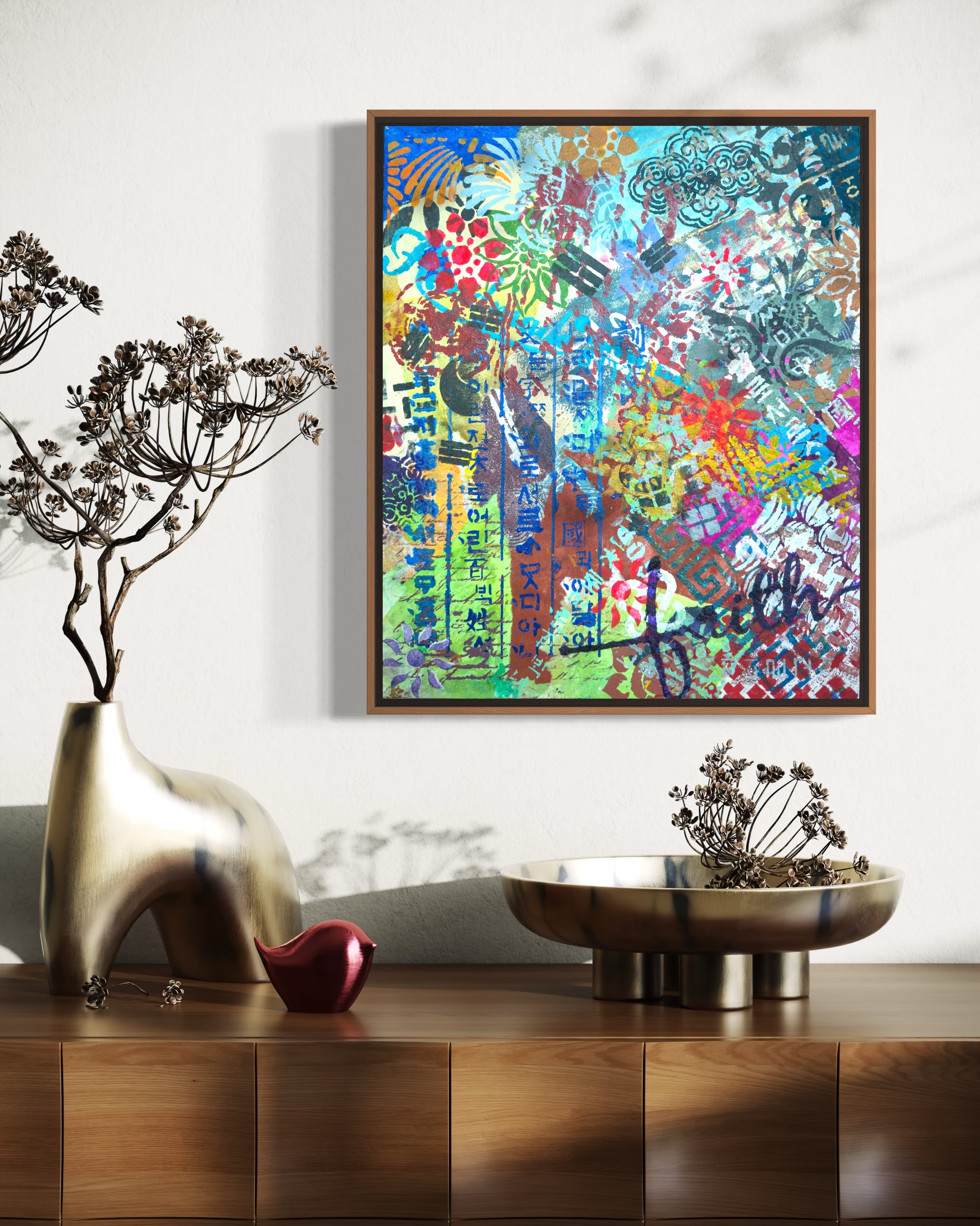


Presence After Permission: Varieties of Patterns, Sounds, Thoughts 03
A critical reflection in the artist's form
The first two works of this series operated as testimony. They asked: Can Korean aesthetic materials survive in a visual field saturated with competing languages? The answers were provisional, earned through material evidence. But the third work, Varieties of Patterns, Sounds, Thoughts 03, inherits these victories but inhabits them differently. There is no longer a struggle to prove. Instead, there is a stranger problem: what happens when what you fought to establish becomes ambient? When K-culture achieves the visibility you once pursued, only to find that visibility itself can be hollow?
The Collapse of the Frontier
The artist's canvas records the instant when the frontier dissolves. The dyed hanji—sheets already committed—are placed against one another without the aggressive intensity of earlier work. The overlaps remain deliberate, but the desperation has left them. These papers coexist not because they are struggling but because they have already been acknowledged. The space they inhabit is no longer contested. Yet the work refuses nostalgia. Instead, it documents disorientation. The artist has spent a practice asking whether these forms could matter. Now they matter globally, commercially. The question that emerges is more troubling: Does "mattering" in the marketplace mean anything to the soul?
The Stencil as Refusal
The stenciled patterns—those sharp geometric iterations of dancheong—cut through the composition with undiminished clarity. Black, white, and indigo on dyed hanji. The patterns do not soften to accommodate the paper they mark. They do not apologize. But now their refusal to harmonize reads differently. It is not defiant; it is indifferent. The patterns assert not because assertion is necessary, but because this is simply what they do. The sa-gwae symbol floats among these patterns, stripped of ceremonial weight. It is a shape. Nothing more. This is the most radical move in the work: not the elevation of Korean form but its reduction to pure visual fact.
The Hangul Descends
Vertically along the margin, Hangul characters in dark indigo stencil. The positioning insists on its own logic. This descent mirrors a generational experience. The artist grew up in a time when Western forms seemed the default template for modernity. To be contemporary meant to move away from the local. The childhood dream was to escape into Western visual culture. Now the vectors have reversed. K-culture occupies global space without asking permission. The artist finds herself in a strange position: what she spent her youth seeking externally is now available internally. The question is no longer "How do I access the global?" but "Now that the global has come home, who am I?"
Material as Honesty
The colored hanji continues to absorb pigment, hold depth, and insist on its own weight. The stencil continues to impose geometric order. These materials do not change their behavior because the world has changed. This stubborn material integrity becomes, in 03, the only remaining honesty. The artist cannot speak for "Korean culture" anymore—it speaks for itself, commercially. She cannot defend it; it no longer needs defense. What remains is the direct engagement with materials: the paper knows what it does, the stencil knows its pattern, the overlap creates visual friction that cannot be rationalized away.
Conclusion: The Question Persists
As 2025 closes, the landscape continues to shift. What was rare becomes common. The artist is not interested in pinning down an answer to identity. Instead, she is interested in staying present to the question itself. Having been granted what I fought for, who am I now? In the marketplace of global culture, where everything Korean is already available, what am I actually making? The canvas offers no answer. It only holds the question open, among everything else.
각문각성각상 03: 허락 이후의 현존
비평적 형식을 빌린 작가노트
이 연작의 첫 두 작업은 일종의 증언이었다. 경쟁하는 수많은 언어로 포화된 시각 필드에서 한국 미학 재료가 생존할 수 있는가? 그 답은 물질적 증거로 얻어졌다. 그러나 세 번째 작업인 《각문각성각상 03》은 그 승리를 상속하되 전혀 다른 방식으로 그 공간에 거주한다. 이제 증명을 위한 투쟁은 없다. 대신 더 낯선 문제가 작가 앞에 놓인다. 당신이 세우려 싸웠던 것이 하나의 '배경'이자 '유행'이 되었을 때 무엇이 일어나는가? 방어가 필요했던 형태들이 이제 전 지구적으로 소비될 때, 그 가시성 자체가 공허하다는 것을 발견한다면?
전선의 붕괴
작가의 캔버스는 전선(frontier)이 해체되는 순간을 기록한다. 이미 염색되고 결정된 색한지들이 초기 작업의 공격적 강렬함 없이 서로에게 놓인다. 겹침은 여전히 의도적이지만, 거기서 절박함은 떠났다. 이 종이들은 투쟁하기 때문이 아니라 이미 인정받았기 때문에 공존한다. 그러나 이 작업은 향수나 축하를 거부한다. 대신 방향 상실을 기록한다. 작가는 이 형태들이 '중요해질 수 있는지'를 물으며 작업해 왔다. 이제 그것들은 전 지구적으로, 상업적으로 중요하다. 여기서 괴로운 질문이 터져 나온다. "상업적으로 중요하다는 것이 영혼에게도 의미가 있는가?"
스텐실로서의 거부
단청 전통의 날카로운 기하학적 반복인 스텐실 무늬들은 명확하게 구성을 뚫고 나간다. 색한지 위의 검정, 흰색, 그리고 진청색 아크릴. 무늬는 자신이 찍히는 종이에 맞추기 위해 부드러워지지 않는다. 사과하지 않는다. 초기 연작의 논리와 일치하지만, 조화하기를 거부하는 그들의 태도가 이제는 다르게 읽힌다. 그것은 도전이 아니라 '무관심'에 가깝다. 무늬는 주장이 필요해서가 아니라, 단지 그것이 그들의 속성이기에 존재한다. 사괘 기호는 의례적 무게를 벗은 채 이들 사이에 떠다닌다. 그것은 형태일 뿐, 그 이상도 이하도 아니다. 한국적 형태를 숭상하는 것이 아니라 순수한 시각적 사실로 축약하는 것, 이것이 이번 작업의 가장 급진적인 움직임이다.
한글의 하강
여백을 따라 수직으로 내려오는 어두운 청색 스텐실의 한글들. 이 하강은 세대적 경험을 반영한다. 작가는 서양 형태가 현대성의 기본 틀이었던 시대에 성장했다. 동시대적이 된다는 것은 지역적인 것에서 떠나는 것을 의미했다. 어린 시절의 꿈은 서양 시각 문화로의 탈출이었다. 이제 벡터가 역전했다. K-문화가 허락 없이 세계 공간을 점유한다. 작가는 낯선 위치에 서 있다. 청년 시절 외부에서 추구했던 것이 이제 내부에서 가능해졌다. 질문은 더 이상 "내가 어떻게 세계에 접근하는가"가 아니라 "세계가 이미 집에 왔을 때, 나는 누구인가"로 옮겨간다.
물질로서의 정직
색한지는 안료를 섬유 구조에 흡수하고, 깊이를 유지하며, 자신의 무게를 주장한다. 스텐실은 기하학적 질서를 부과한다. 이 재료들은 세계가 변했다고 자신의 행동을 바꾸지 않는다. 이 완고한 물질적 무결성은 03번 작업에서 유일하게 남은 정직함이 된다. 작가는 더 이상 '한국 문화'를 대변할 필요가 없다. 그것은 이미 상업적으로 자신을 대변하고 있기 때문이다. 남은 것은 재료와의 직접적인 참여뿐이다. 종이는 자신이 하는 일을 알고, 스텐실은 자신의 패턴을 안다. 겹침은 합리화될 수 없는 시각적 마찰을 만든다.
결론: 질문은 지속한다
2025년이 저물어갈 때, 풍경은 계속 변한다. 희귀한 것이 흔해진다. 작가는 정체성에 대한 답을 고정하는 데 관심이 없다. 대신 질문 자체에 현존하는 데 집중한다. 내가 싸웠던 것을 허락받은 지금, 나는 누구인가? 모든 한국적인 것이 이미 시장에 나와 있을 때, 나는 실제로 무엇을 만들고 있는가? 캔버스는 답을 내놓지 않는다. 다만 다른 모든 것들 사이에서 그 질문을 열린 채로, 밝고 명확하게 붙들고 있을 뿐이다.
허락 이후: 증명 없는 회화
After Permission: Painting Without Proof
각문각성각상 03에 대하여
On Varieties of Patterns, Sounds, Thoughts 03
There is no shortage today of paintings that mobilize Korean patterns, materials, and visual codes. What is scarce is work that no longer feels the need to explain them.
Varieties of Patterns, Sounds, Thoughts 03 belongs firmly to the latter category. It is not a painting that argues for identity. It does not stage a negotiation between tradition and contemporaneity. Instead, it assumes that this negotiation has already taken place—and moves on.
The surface is dense but unforced. Dyed hanji papers overlap with a confidence that comes from familiarity, not urgency. Colors coexist rather than compete. Geometric dancheong-derived patterns, applied through stencil, remain crisp and assertive, yet curiously unambitious. They do not seek harmony, nor do they demand attention. They simply persist.
Hangul appears vertically along the picture plane, neither centered nor ornamental. At first legible, then fragmentary, the text eventually relinquishes meaning in favor of presence. This shift—from reading to seeing—is crucial. Language here is not a message but a material condition.
What distinguishes this work from many contemporaries is restraint. There is no didactic impulse, no symbolic overload. The painting trusts its materials. Hanji absorbs pigment and holds depth. Stencil imposes structure. Overlaps create friction without drama. The result is a surface that feels lived-in rather than performed.
This restraint marks a departure from the series' earlier works. Where the first painting operated at maximum density—every element competing for space—and the second established hierarchies through material endurance, the third relaxes its grip. Not softening, but ceasing to assert. The patterns no longer fight because the fight is over.
This shift registers a generational condition. For artists formed when Western aesthetics represented the horizon of artistic legitimacy, Korean materials required justification. They needed to prove they could operate within "contemporary" discourse. That proving is finished—not because the argument was won, but because the terms have changed. K-culture now circulates globally as fact rather than aspiration.
The problem: what does an artist make when the question that structured her practice has been answered by forces outside her control?
Kim Jun-sung's response is to stay with materials. When cultural discourse becomes ambient noise, when recognition becomes marketplace fact, what persists is the direct engagement with paper, pigment, pattern. Hanji does not change its behavior because the world has changed. This stubborn material integrity becomes the work's quiet anchor.
The painting does not celebrate Korean culture's global visibility, nor does it critique that visibility's commercial frame. It simply continues. This continuation—neither triumphant nor apologetic—is the work's most radical gesture. It refuses both nationalist pride and postcolonial anxiety. It paints as if permission were never the issue.
Whether this constitutes compelling visual art or merely honest documentation remains open. The surface feels less resolved than the artist's statement suggests—patterns coexist without quite speaking to each other, density accumulates without building toward resolution. But perhaps irresolution is the point. Perhaps the painting is performing the very uncertainty it describes.
If the earlier works asked whether Korean visual language could survive, this third asks: having survived, what do I actually choose to keep? What is mine beneath the noise?
The painting does not answer. It stays with the question. And in doing so, it achieves a rare clarity: not the clarity of explanation, but the clarity of presence.
오늘날 한국적 패턴과 재료, 시각 언어를 사용하는 회화는 넘쳐난다. 그러나 그것들을 설명하지 않아도 된다고 느끼는 작업은 드물다.
《각문각성각상 03》은 분명히 후자에 속한다. 이 그림은 정체성을 주장하지 않는다. 전통과 동시대성 사이의 협상을 연출하지도 않는다. 대신 그 협상은 이미 끝났다는 전제 위에 서 있다.
화면은 밀도 높지만 조급하지 않다. 색을 먹인 한지들은 긴급함이 아니라 익숙함에서 나온 확신으로 겹친다. 색들은 경쟁하지 않고 공존한다. 스텐실로 찍힌 단청 기하학 패턴은 여전히 선명하고 단호하지만, 이상하리만큼 야심이 없다. 조화를 요구하지도, 시선을 강요하지도 않는다. 그저 지속될 뿐이다.
한글은 화면을 따라 수직으로 등장한다. 중심도 아니고 장식도 아니다. 처음엔 읽히다가, 이내 파편화되고, 결국 의미를 내려놓는다. 여기서 중요한 전환이 일어난다. 읽기에서 보기로. 언어는 메시지가 아니라 물질적 조건이 된다.
이 작업을 동시대의 유사한 작업들과 구분 짓는 것은 절제다. 상징의 과잉도, 교훈적인 태도도 없다. 그림은 재료를 신뢰한다. 한지는 안료를 흡수하고 깊이를 유지한다. 스텐실은 구조를 부과한다. 겹침은 드라마 없이 마찰을 만든다. 그 결과 화면은 연출된 것보다 '살아온 것'처럼 보인다.
이 절제는 연작의 초기 작업들로부터의 이탈을 표시한다. 첫 번째 작업이 최대 밀도에서 작동했다면—모든 요소가 공간을 두고 경쟁—두 번째가 물질적 인내를 통해 위계를 확립했다면, 세 번째는 쥔 손을 푼다. 부드러워지는 것이 아니라, 주장을 멈추는 것이다. 패턴들은 더 이상 싸우지 않는다. 싸움이 끝났기 때문이다.
이 전환은 세대적 조건을 등록한다. 서양 미학이 예술적 정당성의 지평을 대표했던 시절에 형성된 작가들에게, 한국 재료는 정당화를 필요로 했다. "동시대" 담론 내에서 작동할 수 있음을 증명해야 했다. 그 증명은 끝났다—논증이 이겼기 때문이 아니라, 조건이 바뀌었기 때문이다. K-문화는 이제 열망이 아니라 사실로서 글로벌로 유통된다.
문제: 작가의 실천을 구조화했던 질문이 자신의 통제 밖 힘들에 의해 답해졌을 때, 작가는 무엇을 만드는가?
김준성의 응답은 재료와 함께 머무는 것이다. 문화 담론이 배경 소음이 될 때, 인정이 시장 사실이 될 때, 지속하는 것은 종이, 안료, 패턴과의 직접적 참여다. 한지는 세계가 변했다고 자신의 행동을 바꾸지 않는다. 이 완고한 물질적 무결성이 작품의 조용한 닻이 된다.
이 그림은 한국 문화의 글로벌 가시성을 축하하지도, 그 가시성의 상업적 틀을 비판하지도 않는다. 그저 계속한다. 이 계속—승리적이지도 사과하지도 않는—이 작품의 가장 급진적 제스처다. 민족주의적 자부심과 탈식민적 불안 둘 다 거부한다. 허락이 결코 문제가 아니었던 것처럼 그린다.
이것이 설득력 있는 시각 예술을 구성하는지 아니면 단지 정직한 기록인지는 열려 있다. 표면은 작가 진술이 시사하는 것보다 덜 해결된 느낌이다—패턴들은 서로에게 말하지 않으면서 공존하고, 밀도는 해결을 향해 쌓이지 않으면서 축적된다. 하지만 아마 미해결이 요점일 것이다. 아마 그림은 자신이 묘사하는 바로 그 불확실성을 수행하고 있다.
초기 작업들이 한국 시각 언어가 생존할 수 있는지를 물었다면, 이 세 번째는 묻는다: 생존했으니, 나는 실제로 무엇을 지키기로 선택하는가? 소음 아래 진정 내 것은 무엇인가?
이 그림은 답하지 않는다. 질문과 함께 머문다. 그리고 바로 그 지점에서, 설명의 명료함이 아닌 존재의 명료함에 도달한다.
'Art > 각양각색(Varieties) Series' 카테고리의 다른 글
| 각문각성각상(各文各聲各想) 05 (0) | 2025.12.26 |
|---|---|
| 각문각성각상(各文各聲各想) 04 (0) | 2025.12.23 |
| 각문각성각상(各文各聲各想) 02 (0) | 2025.12.17 |
| 각문각성각상(各文各聲各想) 01 (0) | 2025.12.16 |
| As One Pleases 02 (0) | 2025.10.21 |