2025. 12. 26. 10:08ㆍArt/각양각색(Varieties) Series

각문각성각상(各文各聲各想) 05
VARIETIES OF PATTERNS, SOUNDS, THOUGHTS 05
Series: 각양각색 (各樣各色, The Varieties)
Mixed media on canvas (Dyed hanji and gel-printed hanji collage, acrylic stencil)
재료: 캔버스에 혼합재료 (염색한지와 젤프린팅 한지 콜라주, 아크릴 스텐실)
Size: 60.5 × 50 cm (F12)
Year: 2025
https://www.singulart.com/en/artworks/kim-jun-sung-varieties-of-patterns-sounds-thoughts-05-2516842
Nothing here waits its turn.
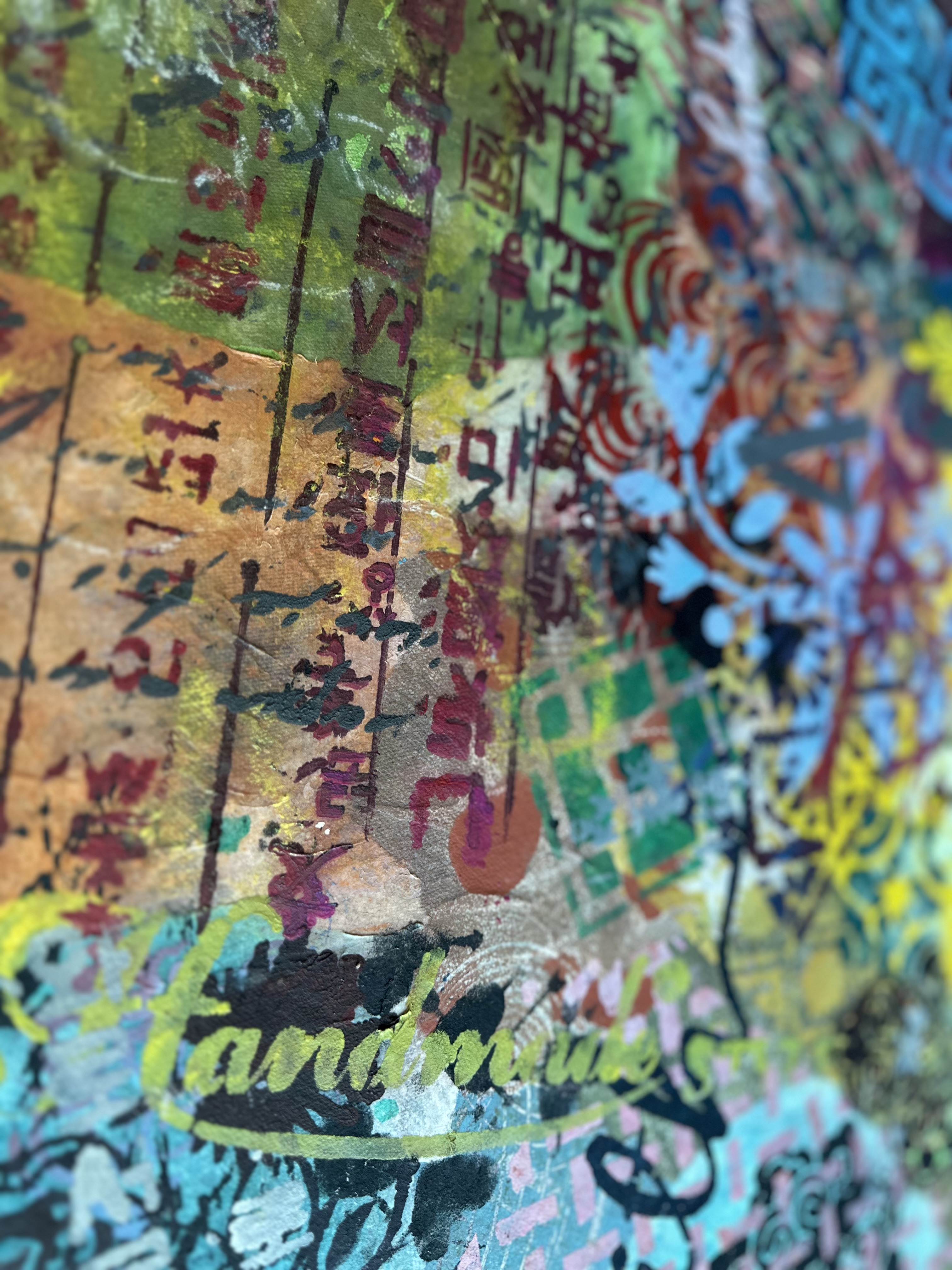
Forms arrive all at once—patterns collide, scripts cross, colors push forward without apology. This is not a composition; it is an overflow. What once held its edge begins to soften; what dissolves refuses to disappear.
This surface does not organize abundance. It withstands it.
I gave up the illusion of control, and in that surrender, the space opened. Look at the upper right, where rigidity melts into pure sensation. This is the sound of a canvas exhaling. What emerges is not harmony but radiance: the intensity of elements sharing one field without surrendering their nature. Not agreement, but coexistence at full volume.
여기서 아무것도 차례를 기다리지 않는다.
형태들은 동시에 도착한다. 문양은 충돌하고, 문자는 교차하며, 색은 사과 없이 전면으로 밀려온다. 이것은 구성이 아니라 넘침이다.
한때 경계를 지키던 것들은 부드러워지고, 해체되는 것들조차 끝내 사라지지 않는다. 이 표면은 풍요를 정리하지 않는다. 다만 견뎌낸다.
나는 통제라는 환상을 버렸고, 그 포기 속에서 비로소 공간이 열렸다. 우측 상단을 보라. 경직된 형태가 순수한 감각으로 녹아내리는 저곳을. 이것은 캔버스가 내뱉는 안도의 한숨이다. 여기서 생겨나는 것은 조화가 아니라 광채다. 서로의 본성을 포기하지 않은 요소들이 같은 장을 공유할 때 발생하는 강도. 합의가 아니라, 최대 음량의 공존이다.
The Radical Generosity of Open Space
Varieties 05 marks a definitive shift from managed tension to sovereign release. Where earlier works compressed energy inside a square, this expanded field releases the pressure. This change is not simply spatial; it is permission. The painting operates through accumulation rather than composition. Dyed hanji absorbs pigment at different speeds, creating a "grown depth" that resists predetermined plans. Over this, gel-printed layers record repetition, only to be loosened again by the paper’s pull.
I stopped conducting the orchestra. I let the Dancheong clouds scatter without architectural duty. I let the Korean script anchor the edges while spreading laterally, refusing to choose a single direction. Some forms remain sharply defined, while others blur, bleed, or drift into atmosphere. The work does not reconcile these behaviors. No hierarchy resolves the field.
What it proposes is not balance, but stamina—the capacity of a surface to hold contradiction without collapse, and of difference to persist without being solved. The painting refuses explanation and trusts the viewer’s ability to navigate density without guidance. It is a field where everything insists on being alive, loud, and present all at once. Expansion becomes accommodation—a spatial generosity that lets every element exist at its own fever pitch.
열린 공간의 급진적 관대함
《각문각성각상 05》는 관리된 긴장에서 주권적 해방으로 넘어가는 연작의 결정적 전환점이다. 이전 작업들이 정사각형 안에 에너지를 압축했다면, 확장된 장은 그 압력을 해제한다. 이는 단순한 크기의 변화가 아니라, 허락의 발생이다. 회화는 구성보다 축적을 통해 작동한다. 염색한지는 서로 다른 속도로 안료를 흡수하며, 배치된 깊이가 아니라 자라난 깊이를 만든다. 그 위로 젤프린팅의 층위가 반복의 흔적을 남기지만, 종이의 유기적인 힘은 그 명료함조차 다시 풀어놓는다.
나는 지휘를 멈췄다. 단청 구름이 건축적 의무 없이 흩어지게 두었고, 한국 문자가 가장자리에 닻을 내리는 동시에 수평으로 뻗어 나가며 단 하나의 방향을 선택하라는 강요를 거부하게 두었다. 어떤 형태는 끝까지 날카로움을 유지하고, 어떤 것은 번지거나 대기 속으로 흩어진다. 작업은 이를 화해시키지 않는다. 어떤 위계도 이 장을 조직하지 않는다.
여기서 제안되는 것은 균형이 아니라 지구력—모순을 무너지지 않고 견디는 표면의 힘이며, 해결되지 않은 채 지속되는 차이의 힘이다. 이 그림은 설명을 거부하며, 관람자가 밀도를 스스로 탐색할 수 있음을 신뢰한다. 이것은 모든 것이 동시에 살아 있고, 소란하며, 현존하려 요동치는 하나의 장이다. 확장은 곧 수용이 된다. 모든 요소가 각자의 비등점에서 존재하도록 내버려 두는 공간적 관대함을 통해서다.
Accommodation: After Control, Beyond Order
By the time Varieties 05 arrives, the demand for proof has exhausted itself. Earlier works asked if disparate forms—scripts, patterns, colors drawn from different systems—could coexist without collapsing into decoration. They did. 05 starts where that survival ends. It operates in the realm of overflow, after the proof has been established.
The Thermal Gradient: Functional Release
The most visible shift is structural. The move to an expanded format is not an aesthetic upgrade but a functional release. The square demanded rotational balance and equal pressure; nothing could dominate, and nothing could rest. In 05, pressure lifts. The added space does not create order—it creates breath. The artist stops directing where things should go. This decision is physical rather than theoretical. Materials are allowed to behave according to their nature. Dyed hanji absorbs pigment beyond precise control, allowing color to sink, spread, and soften.
The upper areas of the canvas reveal this shift most clearly. Edges lose authority. Forms dissolve into atmosphere. What might once have been corrected is now sustained. This softening is not weakness; it is the visible effect of permission. When space is no longer scarce, borders no longer need to be defended. This is the aesthetics of dissolution—a visual sign of the canvas finally being allowed to breathe.
Stamina Without Synthesis
The work accommodates abundance without organizing it into a hierarchy. Throughout the surface, traditional motifs appear without obligation. Dancheong cloud patterns drift without architectural hierarchy. Geometric keys cut through the field but organize nothing. Korean script maintains its vertical logic while simultaneously spreading laterally, refusing to choose between directions. These elements do not merge into a unified language. They persist side by side through difference.
What holds the painting together is not harmony but stamina. The surface proves capable of carrying sharpness and blur, assertion and dissolution, saturation and pause at the same time. Density accumulates without collapse. Light moves through layers of paper rather than sitting on top of them, creating an internal radiance that comes from depth, not polish.
This is the work's radical proposition: Difference does not need to be solved; it needs to be trusted. The painting trusts the viewer’s capacity to wander, to linger, to accept excess without needing it to be explained. Expansion becomes accommodation—not through a tidy synthesis, but through a spatial generosity that lets every element exist at its own fever pitch. Standing before Varieties 05 is to witness a field where difference is no longer a problem to be fixed, but a force allowed to exist at full volume. This is painting after permission is granted. This is the ecstasy of excess.
수용: 통제 이후, 질서 너머
《각문각성각상 05》에 이르러, 증명에 대한 요구는 이미 소진되어 있다. 연작의 초기 작업들이 서로 다른 문자, 문양, 색의 체계가 장식으로 환원되지 않고 공존할 수 있는지를 물었다면, 이제 그 가능성은 더 이상 의심되지 않는다. 05번은 그 생존이 끝나는 지점, 즉 증명 이후의 영역에서 작동한다. 이 작업은 협상하지 않는다. 오직 넘쳐흐를 뿐이다.
온도 구배: 기능적 해방
가장 분명한 변화는 구조적이다. 확장된 포맷으로의 이동은 미적 선택이 아니라 기능적 해방이다. 정사각형은 모든 요소를 동등한 압력 아래 두었고, 그 안에서 아무것도 지배할 수 없었으며 동시에 아무것도 쉴 수 없었다. 05번에서는 그 압력이 풀린다. 추가된 공간은 질서를 만들지 않고, 숨을 만든다. 작가는 무엇이 어디에 있어야 하는지 지시하기를 멈춘다. 이 결정은 이론적이라기보다 물리적이다. 염색한지는 통제의 범위를 넘어 안료를 흡수하며 스며들고 번진다.
화면의 상부에서는 이 변화가 가장 선명하게 드러난다. 경계는 힘을 잃고 형태는 대기 속으로 해체된다. 이전 같으면 수정되었을 이 상태는 이제 유지된다. 이는 약화가 아니라 허락의 결과다. 공간이 더 이상 부족하지 않을 때, 형태는 더 이상 경계를 방어할 필요를 잃는다. 이것이 해체의 미학이며, 캔버스가 마침내 숨을 쉬게 되었음을 알리는 시각적 신호다.
합성 없는 지구력
작업은 풍요를 수용하되 위계로 조직하지 않는다. 화면 전반에서 전통적 모티프들은 의무 없이 등장한다. 단청 구름은 위계를 표시하지 않고 표류하며, 기하학 문양은 질서를 만들지 않는다. 한국 문자는 수직성을 유지하면서도 수평으로 확장되며, 단 하나의 방향을 선택하기를 거부한다. 이 요소들은 하나의 언어로 통합되지 않는다. 차이를 유지한 채 나란히 지속될 뿐이다.
이 회화를 지탱하는 것은 조화가 아니라 지구력이다. 날카로움과 흐림, 주장과 해체, 포화와 여백이 동시에 무너지지 않고 공존할 수 있는 표면의 힘. 밀도는 붕괴 없이 축적된다. 빛은 색 위에 얹히지 않고 종이의 층위 속을 통과하며, 매끄러운 광택이 아닌 깊이에서 기인하는 내부의 광채를 만든다.
이것이 이 작업의 급진적인 명제다: 차이는 해결되어야 할 문제가 아니라, 신뢰받아야 할 상태다. 그림은 관람자가 설명을 요구하지 않고도 이 과잉을 받아들이며 헤매고 머물 수 있는 능력을 신뢰한다. 확장은 곧 수용이 된다. 깔끔한 합성을 통해서가 아니라, 모든 요소가 각자의 비등점에서 존재하도록 내버려 두는 공간적 관대함을 통해서다. 《각문각성각상 05》 앞에 서는 것은 차이가 더 이상 고쳐야 할 문제가 아니라, 최대 음량으로 현존하도록 허용된 힘이 되는 장을 목격하는 일이다. 이것은 허락이 주어진 이후의 회화다. 이것은 과잉이 주는 황홀경이다.




After Permission: Stamina, Saturation, and the Ethics of Coexistence
On Varieties of Patterns, Sounds, Thoughts 05 (2025)
In Varieties of Patterns, Sounds, Thoughts 05, the artist reaches a point at which justification is no longer the operative concern. The painting does not attempt to prove the viability of hybridity, nor does it stage a reconciliation between disparate visual systems. Instead, it assumes that such questions have already been settled and proceeds from a more consequential premise: what happens after coexistence has been secured, when difference no longer needs to explain itself?
This work, the final piece in the Varieties series, marks a shift away from compositional negotiation toward a condition of sustained excess. Earlier paintings in the series operated under visible constraints. Their square formats imposed a centrifugal balance in which no single direction could dominate, and no element could fully rest. Within those limits, motifs drawn from different cultural, graphic, and ornamental traditions were compressed into a shared surface, their coexistence carefully managed through tension and containment.
The transition to the F12 vertical format in 05 is therefore not a matter of scale but of function. The expanded field releases pressure rather than reorganizing it. Space is no longer a scarce resource to be defended; it becomes an enabling condition. As a result, the painting no longer behaves as a composition in the classical sense. It operates through accumulation—of paper, pigment, gesture, and visual memory—without submitting that accumulation to a final hierarchy.
Material behavior is central to this shift. Dyed hanji, with its variable absorbency, plays a decisive role in undermining the authority of edges. Pigment does not simply sit on the surface; it sinks, spreads, and softens according to the paper’s internal logic. Gel-printed hanji introduces repetition and mechanical residue, yet these layers are repeatedly loosened by the organic pull of the paper beneath. Acrylic stencil marks, typically associated with precision and control, lose their dominance as the surface permits slippage and bleed.
This loosening is most apparent in the upper regions of the canvas, where forms appear to dissolve into atmosphere. What might once have been corrected or sharpened is now sustained. This is not a failure of control but a deliberate refusal to reassert it. The painting’s most striking passages emerge precisely where clarity gives way to permeability. Here, dissolution functions not as erosion but as evidence of permission—an indication that the surface no longer requires constant defense.
Crucially, the work does not convert this material generosity into harmony. Motifs traditionally associated with order or structure do not assume organizing roles. Dancheong-inspired cloud forms drift without architectural obligation. Geometric patterns cut across the field but establish no governing grid. Script-based elements retain their directional identities while simultaneously resisting any singular reading path. None of these components is asked to resolve into a unified language.
What holds the painting together is not synthesis but stamina—the capacity of a surface to sustain contradictory behaviors without collapse. Sharpness and blur, assertion and drift, saturation and pause coexist without subordinating one another. Density accumulates, but it does not overwhelm. Instead of offering visual relief through reduction, the painting demands endurance—from itself and from the viewer.
This endurance is ethical as much as aesthetic. In refusing to prioritize one system over another, the painting rejects the familiar narrative of fusion as progress. Difference is neither romanticized nor neutralized; it is allowed to persist unresolved. The work proposes that coexistence does not require consensus, and that visual excess need not be disciplined into coherence to be meaningful.
The experience of encountering Varieties 05 is therefore not one of decoding but of navigation. The painting does not guide the eye through a prescribed sequence, nor does it reward prolonged viewing with a singular interpretive payoff. Instead, it invites lingering, wandering, and partial engagement. Attention can settle anywhere and move on without penalty. The surface trusts the viewer to tolerate density without demanding explanation.
Light plays a subtle but critical role in this dynamic. Rather than reflecting uniformly from the surface, it moves through layers of paper, producing an internal radiance that feels embedded rather than applied. This depth resists polish. The glow that emerges is not decorative but structural—a consequence of accumulation rather than finish.
In this sense, Varieties 05 can be understood as a painting that operates after permission. It no longer asks whether its materials, motifs, or references are allowed to coexist. That question has been answered through practice. What remains is the challenge of sustaining that coexistence at full intensity. The painting accepts this challenge without attempting to resolve it, offering instead a model of accommodation grounded in spatial generosity and material trust.
Standing before the work, one does not encounter a solution but a condition: a field in which difference persists without apology, hierarchy, or synthesis. It is this condition—neither chaotic nor ordered, neither unified nor fragmented—that gives the painting its quiet authority. Varieties of Patterns, Sounds, Thoughts 05 does not seek to conclude the series by bringing its elements into harmony. It concludes by demonstrating that harmony is no longer required.
허락 이후: 지구력, 포화, 그리고 공존의 윤리
《각문각성각상 05》(2025)에 대하여
《각문각성각상 05》에서 작가는 더 이상 정당화를 작업의 출발점으로 삼지 않는다. 이 회화는 혼종성의 유효성을 증명하려 들지 않으며, 서로 다른 시각 체계들을 화해의 서사로 봉합하지도 않는다. 대신, 이미 그 질문들이 소진되었다는 전제에서 출발한다. 이 작업이 묻는 것은 다르다. 공존이 확보된 이후, 차이가 더 이상 자신을 설명할 필요가 없을 때 무엇이 발생하는가?
이 연작의 마지막 작품인 05번은, 구성적 협상에서 지속되는 과잉의 상태로 이동한다. 이전 작업들은 분명한 제약 안에서 작동했다. 정사각형 포맷은 어느 한 방향도 지배하지 못하는 원심적 균형을 요구했고, 그 안에서 모든 요소는 긴장 속에 압축되어야 했다. 서로 다른 문화적·그래픽적·장식적 전통에서 온 모티프들은 공존했지만, 그 공존은 항상 관리되고 통제된 상태였다.
F12 수직 포맷으로의 전환은 크기의 문제가 아니라 기능의 변화다. 확장된 장은 압력을 재조직하는 대신 해제한다. 공간은 더 이상 방어해야 할 자원이 아니라, 작동을 가능하게 하는 조건이 된다. 그 결과, 이 회화는 더 이상 고전적인 의미의 ‘구성’으로 읽히지 않는다. 종이, 안료, 제스처, 시각적 기억의 축적이 위계 없이 병치되며, 최종적인 질서로 수렴하지 않는다.
이 변화의 핵심에는 재료의 행위가 있다. 흡수 속도가 일정하지 않은 염색한지는 경계의 권위를 무너뜨린다. 안료는 표면 위에 머무르지 않고 스며들고 번지며, 종이 내부의 논리에 따라 형태를 바꾼다. 젤프린팅 한지는 반복과 기계적 흔적을 남기지만, 그 명료함조차 아래에서 작동하는 종이의 유기적 힘에 의해 느슨해진다. 정밀함과 통제를 전제하는 아크릴 스텐실 또한, 화면 전체가 허락하는 이완 속에서 지배력을 상실한다.
이러한 변화는 특히 화면 상부에서 두드러진다. 형태는 대기 속으로 해체되고, 경계는 힘을 잃는다. 이전 같으면 수정되었을 이 흐릿함은 이제 유지된다. 이는 통제의 실패가 아니라, 통제를 재개하지 않기로 한 결정의 결과다. 가장 인상적인 장면들은 바로 이 명료함의 포기 지점에서 발생한다. 해체는 침식이 아니라 허락의 증거이며, 표면이 더 이상 끊임없이 자신을 방어할 필요가 없다는 신호다.
중요한 것은, 이 물질적 관대함이 조화로 귀결되지 않는다는 점이다. 질서나 구조를 상징하는 모티프들조차 조직적 역할을 맡지 않는다. 단청을 연상시키는 구름 형태는 건축적 위계 없이 표류하고, 기하학적 문양은 화면을 가로지르지만 어떤 격자도 설정하지 않는다. 문자적 요소들 또한 고유의 방향성을 유지하면서, 단일한 읽기 경로를 거부한다. 이 요소들은 하나의 언어로 통합되지 않는다.
이 회화를 지탱하는 것은 합성이 아니라 지구력이다. 날카로움과 흐림, 주장과 유영, 포화와 멈춤이 서로를 압도하지 않은 채 공존할 수 있는 표면의 능력. 밀도는 축적되지만 붕괴하지 않는다. 시각적 해방은 감축을 통해 제공되지 않으며, 대신 관람자에게도 견뎌낼 것을 요구한다.
이 지구력은 미학적이면서 동시에 윤리적이다. 어느 한 체계를 우선하지 않음으로써, 이 작업은 ‘융합’이라는 익숙한 진보 서사를 거부한다. 차이는 미화되지도, 중화되지도 않는다. 해결되지 않은 상태로 지속될 권리를 얻는다. 이 회화는 공존이 합의를 필요로 하지 않으며, 시각적 과잉이 반드시 정돈되어야만 의미를 갖는 것은 아니라는 전제를 제안한다.
《각문각성각상 05》를 마주하는 경험은 해독이 아니라 항해에 가깝다. 이 그림은 시선을 인도하지도, 장시간 응시 끝에 하나의 결론을 보상으로 제시하지도 않는다. 대신 머물고, 이동하고, 부분적으로 관여하는 방식을 허용한다. 어디에 시선을 두어도 무방하며, 언제든 벗어나도 손해가 없다. 표면은 관람자가 설명 없이 밀도를 감내할 수 있음을 신뢰한다.
빛 또한 이 구조에서 중요한 역할을 한다. 빛은 표면 위에서 균질하게 반사되지 않고, 종이의 층위를 통과하며 내부에서 발광한다. 이 광채는 덧입혀진 효과가 아니라, 축적의 결과다. 매끄러운 마감이 아니라 깊이에서 비롯된 빛이다.
이러한 의미에서 《각문각성각상 05》는 ‘허락 이후’의 회화라 할 수 있다. 재료와 모티프, 참조들이 공존할 수 있는지 묻는 단계는 이미 지나갔다. 남은 것은 그 공존을 최대 강도에서 지속시키는 문제다. 이 작업은 그 문제를 해결하려 하지 않는다. 대신, 공간적 관대함과 물질에 대한 신뢰를 통해 그것을 견뎌낸다.
이 작품 앞에 선다는 것은 하나의 해답을 만나는 일이 아니라, 하나의 상태를 경험하는 일이다. 사과도, 위계도, 합성도 없이 차이가 지속되는 장. 혼돈도 질서도 아닌 그 상태에서, 이 회화는 조용하지만 분명한 권위를 획득한다. 《각문각성각상 05》는 요소들을 조화시키며 연작을 마무리하지 않는다. 조화가 더 이상 필요하지 않음을 보여주며 끝난다.
'Art > 각양각색(Varieties) Series' 카테고리의 다른 글
| Counting the Pieces (낱낱의셈) #01 (0) | 2026.05.13 |
|---|---|
| Please Just Let Them Live (0) | 2026.04.12 |
| 각문각성각상(各文各聲各想) 04 (0) | 2025.12.23 |
| 각문각성각상(各文各聲各想) 03 (0) | 2025.12.20 |
| 각문각성각상(各文各聲各想) 02 (0) | 2025.12.17 |