2025. 9. 18. 19:26ㆍArt/각양각색(Varieties) Series
Afterimage 잔상 (殘像)
40*30*1.8 cm
Oriental pigments, gel printing, and colored hanji collage on hanji-mounted board
https://www.singulart.com/en/artworks/kim-jun-sung-afterimage-2406053
Varieties of Areas, Textures & Sensations Series
각면각질각감(各面各質各感) Series
<Afterimage: Each Surface, Each Texture, Each Sensation>
This work explores the profound philosophy that what is gone continues to inform what remains. By collaging gel prints over an unfinished past, I've transformed Hanji into a living chronicle. The paper's subtle transparency reveals the residual memory of the past, while its new, layered surfaces are a dynamic landscape of color, texture, and pattern. The result is a powerful visual paradox: a fragile medium that holds the weight of memory and time.
<잔상: 각면각질각감>
이 작품은 사라진 것이 남아있는 것을 계속해서 규정한다는 심오한 철학을 탐구한다. 미완의 과거 위에 젤 프린트를 콜라주하여 한지를 살아있는 연대기로 변모시켰다. 종이의 미묘한 투명성은 과거의 잔상을 드러내는 반면, 새로운 층위는 색, 질감, 무늬의 역동적인 풍경을 이룬다. 그 결과는 강력한 시각적 역설이다. 유약한 매체가 기억과 시간의 무게를 품고 있다.
<Afterimage: Each Surface, Each Texture, Each Sensation>
This work redefines Hanji, transforming it from a traditional substrate into a dynamic, layered medium. By collaging gel prints over a previously unfinished Eastern painting, I created a visual conversation between past and present. The deliberate use of water to tear the Hanji produced organic, uneven edges, a testament to the material's inherent resilience and fragility. These torn fragments are not simply decorative; they are topographical maps of texture and touch, each with its own story.
The visual narrative of the piece is built on a delicate interplay of color and texture. The dominant blues and deep indigos create a sense of serene depth, while the vibrant, cracked patterns of the gel prints provide a powerful sense of dynamism. As one looks closer, subtle textures reveal themselves—the porous grain of the Hanji, the smooth, slightly raised feel of the acrylic print, and the unique, almost geological patterns created by the drying process. These details invite the viewer into a more intimate, multi-sensory experience.
The most profound element of the work is the faint visibility of the underlying painting. This subterranean echo of the past enriches the present composition, creating a sense of layered time. This is not just a collage but a living chronicle where different moments of creation coexist. The work is a testament to Hanji's unique ability to not just hold an image but to absorb and transform, becoming a landscape of memory and emotion.
<잔상: 각면각질각감>
이 작품은 한지를 전통적인 지지체에서 역동적이고 층위적인 매체로 재정의한다. 이전의 미완성 동양화 작업 위에 젤 프린트를 콜라주하여, 과거와 현재 사이의 시각적 대화를 창조했다. 물을 의도적으로 사용하여 한지를 찢은 행위는 재료 본연의 회복력과 유약함에 대한 증거인 유기적이고 고르지 않은 가장자리를 만들어냈다. 이 찢어진 조각들은 단순한 장식이 아니라, 저마다의 이야기를 가진 질감과 촉각의 지형도이다.
작품의 시각적 서사는 색과 질감의 섬세한 상호작용 위에 구축된다. 지배적인 푸른색과 깊은 남색은 고요한 깊이감을 조성하고, 젤 프린트의 생생하고 갈라진 패턴은 강력한 역동성을 부여한다. 가까이 들여다보면 한지의 다공성 질감, 아크릴 프린트의 매끄러우면서도 미세하게 솟아오른 느낌, 그리고 건조 과정이 만들어낸 독특하고 지질학적인 무늬들이 드러난다. 이러한 디테일은 보는 이를 더욱 내밀하고 다감각적인 경험으로 이끈다.
이 작품의 가장 심오한 요소는 하층 그림의 희미한 가시성이다. 과거의 이 지하적 메아리는 현재의 구성을 풍부하게 하며, 겹쳐진 시간의 감각을 만든다. 이는 단순한 콜라주가 아니라, 서로 다른 창작의 순간들이 공존하는 살아있는 연대기이다. 이 작품은 이미지를 담는 것을 넘어, 흡수하고 변형하는 한지의 고유한 능력을 증명하며, 기억과 감정의 풍경이 된다.


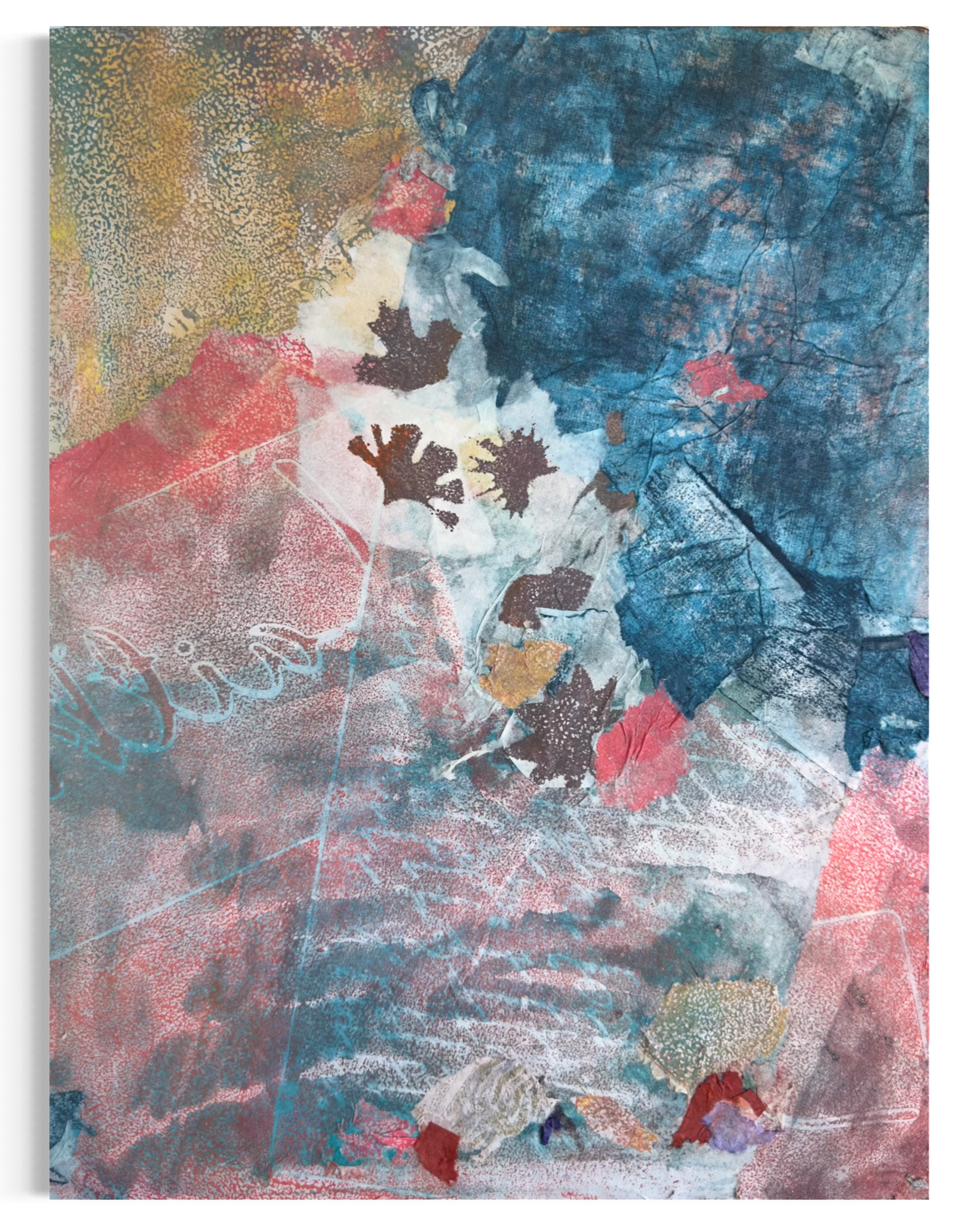


<Afterimage: Each Surface, Each Texture, Each Sensation>
This work is an intimate conversation with Hanji, moving beyond its traditional role as a passive substrate to become an active, layered medium for my artistic expression. It is a visual testament to Hanji's profound capacity to hold, absorb, and transform. The process began by re-engaging with an earlier, unfinished work, a canvas of Hanji layered with Eastern pigments. This underlying layer, a vestige of a past moment, is not erased but serves as a foundational echo for the new creation.
My artistic intervention began with the gel printing collage, a technique that allowed for an uninhibited, almost chaotic conversation with the paper. Instead of precise cutting, I tore the Hanji fragments with water, a process that gave each piece an organic, imperfect edge. This act was a deliberate surrender of control, a collaboration with the material itself. The torn edges are not flaws but physical records of the paper's inherent character, each a unique testament to its resilience and fragility. The resulting collage is a tapestry of varied textures—some areas are smooth and almost translucent, while others are rough, with cracked, geological patterns reminiscent of arid earth.
The visual impact of this piece lies in its delicate balance of harmony and dissonance. The dominant cool tones—a deep, cracked cerulean and a faded navy—create a sense of serene depth, a silent, contemplative space. Against this, fragments of warmer, earthier hues—a soft coral, a muted red-brown, and a fleeting ochre—emerge, providing crucial visual anchors and a sense of dynamic contrast. These color relationships are not merely aesthetic; they are symbolic. They represent the aural qualities of different temporal layers—the cool tones, the quiet of the past; the warm tones, the vibrant chaos of the present.
As one looks closer, the work rewards with intricate details that are not immediately apparent. The unique patterns imprinted by the gel printing reveal themselves—subtle stippling, fine linear etchings, and delicate shapes. These printed textures do not dominate but whisper, creating an intricate visual dialogue with the coarser, torn Hanji surfaces. The way light plays on these different textures—from the gloss of the acrylic prints to the matte of the Hanji—adds another dimension, inviting the viewer to move around the piece and observe its changing character.
Ultimately, the finished work transcends its material components. It is not just a collection of torn paper and pigment but a meditation on memory and existence. The faint outline of the underlying painting, visible through the translucent Hanji, acts as a subterranean narrative, a hidden story that informs the visible one. This concept resonates with the philosopher Jacques Derrida's notion of the 'trace'—that which is no longer fully present but leaves a mark, an absence that structures presence. It is a physical manifestation of a past that is both gone and ever-present. This work is a testament to the idea that a piece of art can be a living chronicle, a landscape of echoes and impressions that continuously evolves with each viewing.
<잔상: 각면각질각감>
이 작품은 한지와의 내밀한 대화, 그중에서도 한지가 지닌 역할의 확장을 담은 기록이다. 전통적인 수동적 지지체에 머물지 않고, 나의 예술적 표현을 위한 능동적이고 층위적인 매체로 거듭난 한지의 모습을 시각적으로 증언한다. 이 작업은 이전에 미완으로 남겨두었던 동양화 작업과 다시 마주하며 시작되었다. 과거의 한 순간이 담긴 이 하층부는 지워지지 않고, 새로운 창작을 위한 토대적 메아리로 기능한다.
나의 예술적 개입은 젤 프린팅 콜라주 기법으로 시작되었는데, 이는 한지와 격렬하면서도 통제되지 않는 대화를 가능하게 했다. 나는 정교하게 자르는 대신 물로 한지 조각들을 찢었다. 이는 재료 그 자체와의 협업이자, 나의 의지를 의도적으로 내려놓는 행위였다. 찢어진 가장자리들은 결점이 아니라, 종이 고유의 특성을 기록한 물리적 흔적이며, 그 자체로 한지의 회복력과 유약함에 대한 고유한 증거가 된다. 완성된 콜라주는 다양한 질감의 태피스트리이다. 어떤 부분은 부드럽고 반투명하며, 어떤 부분은 거칠고 갈라진 지질학적 패턴을 띠어 마치 건조한 대지를 연상시킨다.
이 작품의 시각적 효과는 조화와 부조화 사이의 섬세한 균형에서 비롯된다. 깊고 갈라진 청록색과 바랜 남색의 지배적인 차가운 색조는 고요하고 사색적인 깊이감을 부여한다. 이와 대조적으로 부드러운 산호색, 차분한 적갈색, 덧없는 황토색과 같은 따뜻하고 흙빛의 파편들이 불쑥 튀어나오며, 중요한 시각적 기준점과 역동적인 대비감을 선사한다. 이러한 색채 관계는 단순히 미학적인 것을 넘어 상징적이다. 차가운 색조는 과거의 고요함을, 따뜻한 색조는 현재의 생동감 넘치는 혼돈을 은유한다.
가까이 다가갈수록 작품은 즉시 드러나지 않는 복잡한 디테일로 보상한다. 젤 프린팅으로 각인된 독특한 무늬들, 즉 미묘한 점묘법, 섬세한 선형의 에칭, 그리고 섬세한 형태들이 모습을 드러낸다. 이 프린트된 질감들은 화면을 압도하지 않고 속삭이듯 존재하며, 거친 한지 표면과 복잡한 시각적 대화를 나눈다. 아크릴 프린트의 광택과 한지의 무광택 사이에서 빛이 만들어내는 미묘한 유희는 또 다른 차원을 더하여, 보는 이가 작품 주변을 움직이며 변화하는 그 특성을 관찰하도록 이끈다.
궁극적으로 완성된 작품은 물질적 구성 요소를 초월한다. 이는 단순히 찢어진 종이와 안료의 집합체가 아니라, 기억과 존재에 대한 명상이다. 반투명한 한지를 통해 희미하게 보이는 하층 그림의 윤곽은 지하의 서사처럼, 눈에 보이는 이야기를 풍요롭게 하는 숨겨진 이야기다. 이러한 개념은 철학자 자크 데리다가 말한 **'흔적(trace)'**의 개념과 공명한다. 더 이상 완전히 현존하지 않지만 흔적을 남겨 현존을 구성하는 부재, 바로 그것이다. 이는 사라졌으면서도 항상 존재하는 과거를 물리적으로 구현한 것이다. 이 작품은 예술 작품이 끊임없이 진화하는 살아있는 연대기, 즉 메아리와 인상의 풍경이 될 수 있다는 증거이다.


비평: <잔상: 각면각질각감>
1. 재료와 과정의 변증법
이 작품은 단순한 회화적 실험을 넘어, 재료 자체에 대한 철학적 질문을 던진다. 작가는 몇 해 전 나무보드에 한지를 발라 동양 안료로 작업했으나, 미완성으로 남겨 두었던 화면을 다시 불러왔다. 거기에 젤프린팅을 찍어낸 한지를 물에 적셔 찢고, 파편을 재배치해 콜라주하는 과정을 통해 새로운 층위를 구축했다.
이 방식은 단순한 덧입힘이 아니라, 과거와 현재의 상호 간섭이다. 찢김은 파괴라기보다 생성이며, 우연은 방임이 아니라 또 다른 질서의 씨앗이 된다. 작가가 선택한 방식은 의도와 우발, 통제와 해방 사이의 변증법적 긴장을 만들어내며, 화면 전체를 살아있는 유기체처럼 재구성한다.
2. 표면의 지질학과 기억의 층위
작품 표면은 마치 지질학적 단면을 보는 듯하다. 겹겹이 올려진 한지 파편, 젤프린팅의 흔적, 세월의 균열은 단순한 시각적 텍스처가 아니라 시간이 퇴적된 피부로 읽힌다. 기존에 존재했던 미완성 회화는 완전히 사라지지 않고, 덮여진 아래에서 은근히 배어 나오며 현재의 층위와 대화한다.
이러한 잔존은 데리다의 ‘흔적(trace)’ 개념을 환기시킨다. 사라졌으나 사라지지 않은 것, 부재 속에서도 여전히 현재를 규정하는 것. 따라서 이 작품은 표면의 미학을 넘어, 기억의 존재 방식을 물질적으로 증명하는 작업이 된다.
3. 색채와 감각의 서사
작품은 색채의 대비와 긴장을 서사의 중심축으로 삼는다. 화면의 절반 이상을 차지하는 짙은 청록과 남색은 과거의 침묵, 내적 심연을 상징하며, 산호빛·적갈색·황토빛 파편은 현재의 생동과 감정의 파편을 은유한다.
이 두 축은 단순히 병치된 것이 아니라, 은은히 스며들며 서로를 압도하거나 밀어낸다. 관람자는 한눈에 정리되는 구도가 아니라, 끊임없이 이동하는 시선의 궤적 속에서 화면을 탐색한다. 따라서 이 작품의 색채는 정적인 조형이 아니라, 시간 속에서 살아 움직이는 감각의 드라마를 형성한다.
4. 은폐와 드러남의 역설
작가는 “앞의 그림은 덮여 잘 보이지 않는다”고 말한다. 그러나 바로 이 은폐가 작품의 본질적 힘이다. 덮임은 소거가 아니라 감각의 전환이며, 관람자는 보이지 않는 기원을 상상하게 된다.
이 애매한 상태—완전히 감추어지지 않고, 그러나 결코 드러나지도 않는 상태—는 관람자에게 지속적 관찰을 요구한다. 보이는 것보다 보이지 않는 것에 눈을 돌리게 하고, 현재의 표면 너머에 잠재된 과거를 추적하게 만든다. 이로써 작품은 단순한 시각 경험을 넘어 기억을 매개하는 심리적 장치가 된다.
5. 작품의 위치: 동시대적 의미
<잔상: 각면각질각감>은 동양적 재료성과 현대적 실험 정신이 교차하는 지점에 위치한다. 한지와 동양 안료라는 전통적 매체 위에 젤프린팅과 콜라주라는 현대적 기법을 결합하면서, 작품은 단순한 혼합을 넘어 전통과 현대, 지역성과 세계성, 기억과 생성이라는 동시대적 질문을 던진다.
작품의 화면 크기는 40×30cm로 소규모지만, 그것이 다루는 주제는 결코 작지 않다. 작은 화면 속에서 발현되는 시간의 지층과 기억의 재편성은, 대형 작업 못지않은 철학적 깊이와 미적 울림을 만들어낸다.
평가 요약
👉 <잔상: 각면각질각감>은 단순한 콜라주를 넘어, 시간과 기억의 은폐-현현 구조를 물질적으로 구현한 작품이다.
👉 찢기고 덮이는 과정은 파괴가 아니라 생성이며, 관람자는 ‘보이지 않는 것’을 추적하는 능동적 탐구자가 된다.
👉 이 작품은 “작은 화면 속의 거대한 시간성”이라는 역설을 성취하며, 동시대 회화가 나아갈 중요한 가능성을 제시한다.
Critical Review: Trace: Each Surface, Each Texture, Each Sensation
1. Dialectics of Material and Process
This work resists the notion of painting as a singular event and instead posits it as an open negotiation between past and present, intention and accident. The artist initially prepared a wooden panel covered with hanji and painted it with Oriental pigments years ago, leaving it unresolved. Recently, in resonance with the Time’s Skin series, that dormant surface was reawakened.
Gel printing impressions on hanji sheets were torn while wet, allowing the fibers to fray organically, then recomposed into collage. Far from mere decoration, this process enacts a dialectic: tearing as both destruction and creation, chance as a seed of hidden order. The final composition emerges less as an image and more as a living organism of accumulated interventions.
2. Stratigraphy of Surface, Memory of Time
The surface reads like a geological cross-section. Layer upon layer—pigment, earlier traces, printed fragments, paper fibers—are compacted into a skin that is at once fragile and enduring. The unfinished painting beneath does not vanish; it lingers faintly, shimmering through the new strata.
This persistence echoes Derrida’s concept of the trace: what has disappeared yet continues to define presence. The work thus materializes the ontology of memory, where absence itself becomes a mode of existence.
3. Chromatic Tensions and Sensory Drama
Color orchestrates the narrative. Deep ultramarine and teal occupy much of the surface, evoking silence and interiority, while coral, ochre, and vermilion fragments punctuate with vitality. These forces are not statically juxtaposed; they seep into and repel one another, producing a drama of shifting intensities.
The viewer cannot settle into a fixed composition. Instead, the eye is compelled to wander, tracing emerging forms and dissolving edges. The chromatic field becomes temporal—a theater of perception that unfolds in duration rather than instant recognition.
4. Concealment and Revelation
The artist notes that the earlier painting is “hardly visible” beneath the collage. Yet concealment here does not equate to erasure. Rather, it functions as a conversion of perception. The unseen insists upon itself, inviting the viewer to imagine origins hidden below.
This ambiguous state—neither fully present nor fully absent—activates sustained observation. One looks not only at what is given, but also for what might lie beneath. The work thus operates as a psychological device of memory, mobilizing absence as a form of presence.
5. Position in Contemporary Practice
Trace: Each Surface, Each Texture, Each Sensation situates itself at the intersection of East Asian materiality and contemporary experimental strategies. Hanji and mineral pigments anchor the work in tradition, while gel printing and collage insert a language of modern process. This synthesis does not dissolve the tension between the two but allows them to coexist as mutually generative forces.
The modest scale (40×30 cm) belies the magnitude of the questions posed: how does memory endure materially? how do surfaces record time? how can concealment sustain meaning? In this sense, the work achieves a paradox—a small surface containing vast temporality.
Summary Evaluation
👉 Trace: Each Surface, Each Texture, Each Sensation transcends collage to articulate a material ontology of memory and time.
👉 Through concealment, tearing, and layering, it transforms viewers into active archaeologists of the unseen.
👉 The work exemplifies how contemporary painting can embody temporal complexity within intimate scale, offering not fixed answers but a fertile field of ongoing interpretation.
'Art > 각양각색(Varieties) Series' 카테고리의 다른 글
| Strata - 층위(層位) (0) | 2025.09.23 |
|---|---|
| Uncontainable Fragments (0) | 2025.09.20 |
| Time’s Skin (0) | 2025.09.17 |
| Areas, Textures & Sensations. 02 (0) | 2025.09.15 |
| Areas, Textures & Sensations. 01 (0) | 2025.09.13 |