2025. 11. 6. 06:43ㆍArt/Ag(e)ing Series

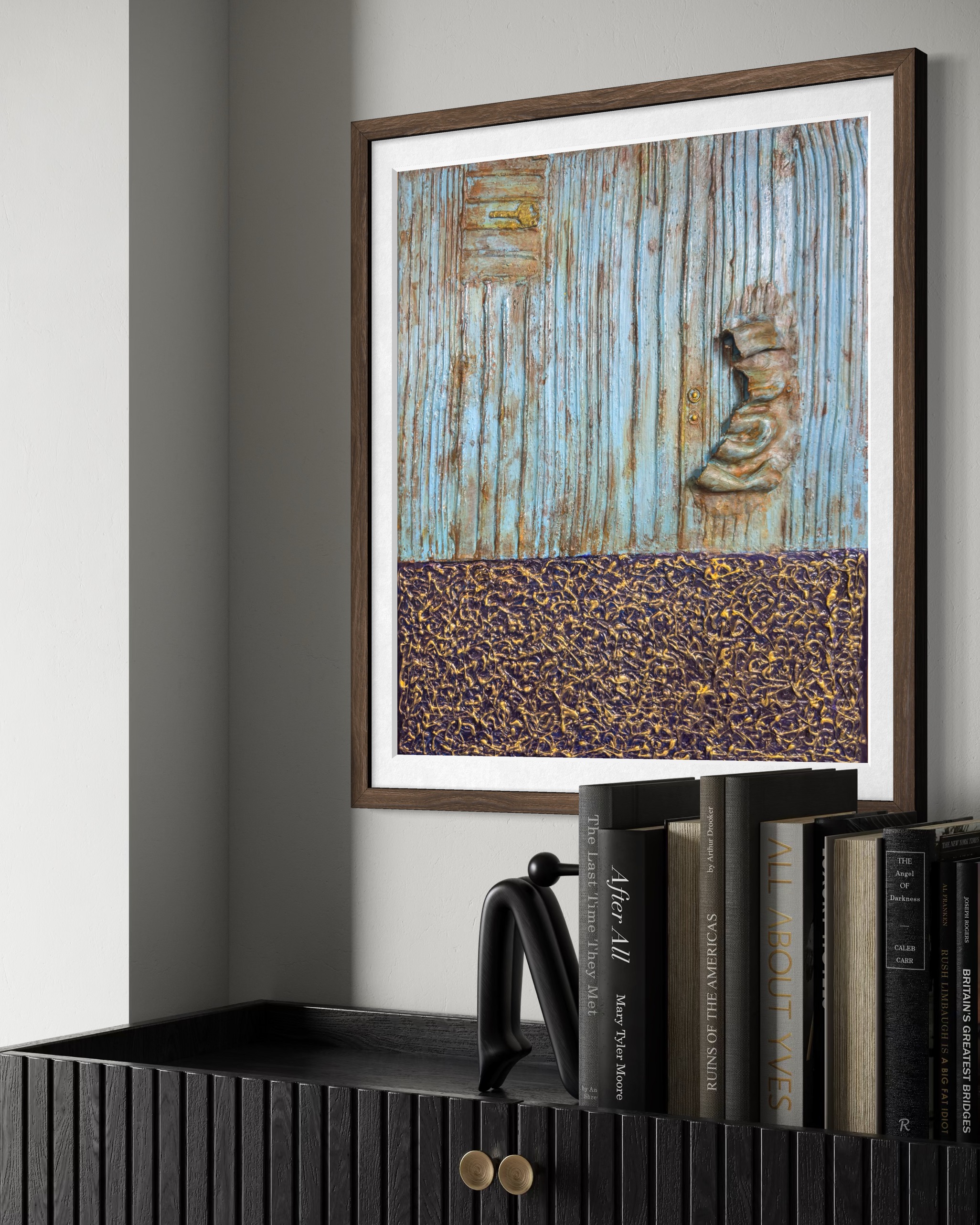
Rusty Orifice - Earhole, Nostril, Throat : I Will Keep Them Open
녹슨 구멍 - 귓구멍, 콧구멍, 목구멍 : 열려 있게 하겠다!
ag(e)ing series #3
Mixed Media on Canvas, 10 F (53 x 45.5 cm)
Modeling Paste, Glue Gun, Clay, Coffee Grounds, Buttons, Acrylic Pigment, Corrosion Paint
Year: 2023-2025 (Original work revised in 2023)
https://jonathank.tistory.com
https://www.singulart.com/en/artworks/kim-jun-sung-rusty-orifice-2461925
Subject Declaration: The work is a vital declaration to defend the essential passages. It is a dual vow: a personal oath to perpetually maintain the channels of hearing, breathing, and truth-telling, and a public demand that the powerful never seal these channels for anyone. The rust is not decay, but the accumulated evidence of this persistent maintenance through time.
주제 선언: 이 작품은 닫혀서는 안 될 세 구멍을 사수하는 생명의 선언이다. 이는 듣고, 숨 쉬고, 진실을 말하는 행위를 지속하겠다는 확고한 서원이며, 이 구멍들을 영원히 열어두도록 요구하는 공공의 메시지를 투영한다. 녹슬음은 쇠락이 아닌, 수많은 마모와 압력에도 기능을 포기하지 않은 완강한 의지의 증거이며, 아래로부터의 변혁이 응축된 시간의 단단한 지반임을 드러낸다.
-----------------------------------------------
Rusty Orifice speaks of the will to remain open—
to keep the ear that still listens, the nostril that still breathes,
the throat that still dares to name truth.
Its clay form gathers the three into one pulse of life,
wounded yet breathing.
Rust grows not from neglect but from endurance;
gold hides the fatigue of false promise.
The key, the buttons, the scars—
all testify to a vow quietly kept through friction and time.
“I will keep them open,” whispers the work,
where even decay becomes a form of faith.
《녹슨 구멍》은 여전히 열려 있으려는 의지에 대해 말한다.
여전히 듣는 귀, 여전히 숨 쉬는 코, 여전히 진실을 말하려는 목.
점토의 형상은 그 셋을 하나의 생명 맥박으로 모은다—상처 입었으나, 여전히 살아 있다.
녹은 방치의 흔적이 아니라 견딤의 기록이며,
금빛은 거짓된 약속의 피로를 숨긴다.
열쇠와 단추, 흉터들은 마찰과 시간 속에서 조용히 지켜온 서약을 증언한다.
“나는 그것들을 열려 있게 하리라.”
그 속에서 부식조차 신앙의 형태가 된다.
-----------------------------------
This canvas is a declaration of the vital passages for human dignity, rebuilt from intentional destruction into an antagonistic topography. The central clay protrusion is the 'Life-Passage Orifice': the ear that resists manipulation; the nostril that demands economic autonomy; the throat that rejects forced silence. The lower mass, gilded with gold, symbolizes the calculated poison of false prosperity. The key is a tool for accessing truth, while the unfastened buttons represent a structural refusal of final closure. The work’s tension is derived from its confrontational relief structure, where the rust serves as a badge of persistent maintenance against assault.
이 캔버스는 순응적 표면을 파열시키며 재건된, 인간 존엄을 위한 생명의 구멍(Orifice)을 선언한다. 녹슨 흔적은 쇠락이 아닌, 모든 폐쇄에 맞서 이 구멍들을 지켜온 치열한 시간을 증언한다.
중앙의 단일한 점토 돌출부는 세 가지 동시적 기능을 내포하며 구축되었다: 외부 조작에 희생되지 않고 진실을 듣는 귀, 경제적 자율성을 요구하는 콧구멍, 명분 없는 침묵을 거부하는 목구멍. 하단부 금빛으로 위장된 덩어리는 기만적인 풍요로 주의를 분산시키는 유혹을 상징하는 배치다. 열쇠는 모든 봉쇄를 뚫는 접근의 도구이며, 잠기지 않은 단추들은 모든 최종적 닫힘을 구조적으로 거부하는 선언을 표명한다.
-------------------------------------
The current work is founded on an act of violence against the original, visually compliant surface. The first iteration established the 'jaws'—deep vertical grooves carved into the modeling paste. The major rework (2023-2025) then began in earnest: these grooves were activated by filling them with coffee grounds and sealing them with gesso. This was followed by the construction of the central clay relief, the key, the buttons, and the lower glue gun mass, transforming the surface into a badge of persistent maintenance.
The central clay relief is not three separate organs but one life-site operating simultaneously. The ear stands against the arrogance of power that only listens to flattery, refusing to be sacrificed to external, manipulative noise. The nostril demands economic autonomy—the space to exist without the mathematics of scarcity dominating every thought, allowing ascent to self-actualization. It insists on penetrating the slow suffocation of survival disguised as life. The throat insists on being the channel for naming injustice as injustice, the instrument of dignity that rejects the gag of forced silence, maintaining the clarity required for public discourse.
The black-purple mass below is gilded, the enemy's tactic: temptation disguised as benefit, darkness wrapped in gloss. Against this, the key is deployed as a tool to breach all closures, and the buttons are intentionally left unfastened as a structural refusal of finality. The rust accumulates from persistent use, not neglect—a patination of maintenance maintained across time.
이 작품은 원래의 순응적 표면을 외과적으로 파열시킨, 해체적 재작업으로부터 시작되었다. 캔버스의 깊은 흠집은 침묵당한 목소리(커피가루)로 봉인되었으며, 그 위에 중앙의 구멍 부조, 열쇠, 단추를 덧대어 구축했다. 이는 닫힘의 압력에 맞서 세 구멍을 지켜온 치열하고 고독한 시간을 보여준다.
중앙의 점토 부조는 세 감각이 통합된 현장으로서, 구멍들이 수행해야 할 기능을 선언한다.
1. 귓구멍: 깨끗하게 듣는 행위의 사수. 이 구멍은 외부의 노이즈와 내부의 자기 기만을 분리해 내는 윤리적 필터 역할을 수행한다. 귀는 안일한 확증편향의 달콤한 유혹을 거부하고, 고통스러운 진실의 주파수만을 객관적으로 수신하는 치열한 의지의 현장이다. 외부의 조작적 소음과 파괴적 사보타지에 희생되지 않으며, 진실의 파장을 선명하게 회복하겠다는 의지를 담고 있다.
2. 콧구멍: 숨 막히는 소진의 질식을 거부하고 자기실현을 요구하는 호흡. 이것은 단순히 생존 단계를 넘어 ‘생존을 넘어선 자율적 삶’을 위한 경제적 공간을 요구하는 의지를 내포한다. 콧구멍은 생존의 산술에 매몰되지 않고, 죄책감 없는 쉼과 정서적 여유를 통해 자기실현의 단계로 나아가려는 의지를 구축한다. 이는 척박한 생존 단계에 인간을 묶어두려는 모든 폭력에 굴복하지 않는 호흡 그 자체다.
3. 목구멍: 명분 없는 침묵을 거부하는 발화의 자리. 이것은 부패와 독재적 기도를 은폐하려는 권력의 통제에 맞서, 불의를 명명(命名)하는 발화의 자리를 사수하겠다는 투쟁의 외침을 담고 있다. 왜곡과 은폐 시도에 굴하지 않고 진실을 똑바로 부르는 존엄의 악기 역할을 담당하며, 공론의 영역에서 정직한 비판을 보장한다.
하단부의 금박 입힌 덩어리는 기만적인 풍요로 주의를 분산시키는 유혹을 상징한다. 이에 맞서 열쇠가 모든 봉쇄를 뚫는 접근의 도구로, 의도적으로 풀려있는 단추가 모든 최종적 닫힘을 거부하는 구조적 선언으로 배치되었다. 녹은 방치 대신 지속적 유지를 통해 얻은 영광스러운 얼룩이다.
--------------------
1. The Act of Reworking: Violence Against Visual Complacency
The original canvas, outwardly pristine and aesthetically compliant, failed to convey the necessary existential tension. Its smooth surface, prioritizing visual harmony, had become a visual representation of a consensus that avoided difficult truths. The artist recognized this deficiency and, to align the material form with the foundational spirit of the work, initiated a surgical, irrevocable rupture of that surface.
The canvas surface was first scored in the initial iteration, forming deep vertical grooves carved into the modeling paste by various wedge tools. These roughened, vertical ridges established the 'jaws'—structural obstacles representing biased hearing, economic suffocation, and moral censorship.
The pivotal rework phase (2023-2025) then commenced by activating this pre-existing topography: the deep cuts were filled with coffee grounds and sealed with gesso. This action symbolized the disregarded detritus of society and the silenced voices being forcefully integrated into the work's structure. Following this sealing, all subsequent primary relief elements—the central Composite Orifice, the Key, the Buttons, and the lower Glue Gun mass—were constructed and applied. The canvas is an anti-monument, demanding that we confront these material facts head-on.
2. The Central Composite Orifice: The Life-Support Mechanism of Moral Society
The central clay protrusion is the life-support mechanism of a moral society, the 'Composite Orifice' where three essential human capacities must remain open, unified, and perpetually functional.
- The Ear: Ethical Defense of the Act of Hearing. This ear is the antenna of conscience, tuned not just to external political threats but to internal self-deception. It vehemently rejects the 'sweet earwax' of complacent confirmation bias and the temptation of willful ignorance. The ear's function is to filter out the noise of propaganda and the subtle 'sabotage' orchestrated by hostile actors, ensuring it can objectively receive the painful frequency of truth. It is the antenna of conscience that refuses to be sacrificed to external, manipulative noise, continuously struggling to restore the clarity of truth.
- The Nostril: The Demand for Breathable Existence and Self-Actualization. This is not merely a demand for bare survival but for a self-directed, actualized existence. The nostril stands against the logic of perpetual exhaustion—the demand that citizens burn themselves as fuel for an economy that rewards only extraction. It demands three forms of oxygen, crucial for ascending the hierarchy of needs:
- Economic Autonomy (The Foundation): The fundamental stability and financial space required to exist without the mathematics of scarcity dominating every thought. This stability is the secure foundation upon which genuine human potential can be erected.
- Temporal Autonomy (The Ascent): The freedom to rest without the penalty of lost income, to pause without the guilt of unproductivity. Time itself has been weaponized—every moment not spent earning is reframed as waste. The nostril demands time returned to human scale, allowing for intellectual and emotional recovery.
- Emotional Capacity (Self-Realization): The capacity to hope beyond tomorrow, to plan futures not dominated by debt and precarity. When economic inequality restricts opportunity, the nostril demands that those who control the valves of economic distribution open the flow. This is not charity, but the fundamental requirement for a society that claims to value human life over the mechanisms of extraction, allowing individuals to reach the stage of self-actualization.
- The Throat: The Physical Conduit of Moral Clarity. This orifice is the absolute rejection of the silencing mechanisms used by corrupt power. It is the site of a sustained, public outcry against political entities that attempt to shield their illegal actions—such as internal rebellion or abuse of power—by leveraging technical ambiguities ("the trial is not over") to delay accountability and justify their autocratic tenure. The throat channels the collective will of the people, refusing to let those who cloak their greed and incompetence in patriotic rhetoric maintain control. It is the voice that demands clarity, that asks the penetrating question, "Is this truly just?" It is the weapon of the protester holding a candle and a support stick, insisting on the incumbent's removal from authority. The throat resists the gag, insisting on the right to name injustice as injustice, to call distortion what it is, and to reject all forms of silencing until justice stands upright. The closing of this channel is the ultimate surrender to the architecture of oppression.
3. The Temptation Below and Tools of Resistance
The lower third of the canvas, with its black-purple glue gun masses systematically gilded with gold acrylic, demonstrates the strategy of sabotage disguised in glistening disguise. This represents the calculated tactic of forces that present oppression as protection and exploitation as opportunity, drawing the eye away from ethical darkness with false beauty.
Against this glittering threat, the artist deploys definitive tools of maintenance and breach:
- The Key (upper left relief) is not merely a symbol but an active, aggressive vow to breach every door, lock, or barrier erected to prevent access to truth or justice. It is the ultimate tool of penetration and defense.
- The Buttons (two unfastened, vertical) remain deliberately open, an intentional failure of closure. They represent a structural refusal to accept 'finality' in any oppressive system, ensuring the canvas maintains a state of un-cinched readiness.
4. The Rust as Honor: The Legacy of Defense
The subtitle serves as the core philosophical premise of this work: "I Will Keep Them Open."
The rust is not a sign of decline or neglect, but a material history and a medal of struggle accumulated from maintaining these orifices amidst adversity. This patina is the tangible evidence of a stubborn will that refused to yield its function despite immense friction and pressure. It is the dignified accumulation of time spent resisting corrosion and demanding continued utility.
This rust is an ethical inheritance and a relic of defense, testifying to a current of resistance that has flowed relentlessly from the deepest layers of society, distinct from the language of domination. One must confront the Rusty Orifices with an acknowledgment of this deep history. The rust represents the material cost paid by a resolute will to keep the channels open against all forces of closure.
1. 재작업의 행위: 시각적 순응성에 대한 파열
원래의 캔버스는 겉으로 보기에 깨끗하고 심미적으로 순응적인 상태였으나, 필요한 실존적 긴장을 전달하는 데 미흡했다. 시각적 조화를 우선시했던 매끄러운 표면은 어려운 진실을 회피하는 합의의 시각적 대변자처럼 변모했다. 이러한 결함을 인식하고, 재료 형태를 작품의 근본 정신과 일치시키기 위해, 그 표면에 대한 외과적이고 돌이킬 수 없는 파열을 단행했다.
캔버스 표면은 초기 단계에서 모델링 페이스트에 다양한 쐐기 도구로 깊은 수직 홈이 새겨지며 득점되었다. 이 거친 수직 융기선은 편향된 청각, 경제적 질식, 도덕적 검열을 상징하는 구조적 장애물을 형성했다.
결정적인 재작업 단계(2023-2025)는 기존의 지형을 활성화하는 것으로 시작되었다. 깊게 새겨진 홈들은 커피 가루로 채워지고 젯소로 봉인되었다. 이 행위는 무시된 사회의 찌꺼기와 침묵당한 목소리들이 작품의 구조에 강제로 통합되었음을 상징한다. 이 봉인 이후, 중앙 복합 구멍 부조, 열쇠, 단추, 하단 글루건 덩어리 등 모든 후속 주요 부조 요소들이 구축되고 적용되었다. 이 캔버스는 반(反)기념물로서, 이러한 물질적 사실들을 정면으로 대면하도록 요구한다.
2. 중앙 복합 구멍: 도덕적 사회의 생명 유지 장치
중앙의 점토 돌출부는 도덕적 사회의 생명 유지 장치를 표현하며, 인간의 세 가지 필수 역량인 듣기, 숨 쉬기, 말하기가 열린 채, 통일되고 영구적으로 기능해야 하는 **'복합 구멍(Composite Orifice)'**을 선언한다.
- 귓구멍: 청각 행위의 윤리적 방어. 이 귀는 외부의 정치적 위협뿐만 아니라 내부의 자기기만에 대해서도 조율되는 양심의 안테나를 구축한다. 그것은 안일한 확증편향의 **'달콤한 귀지'**와 고의적인 무지의 유혹을 격렬하게 거부한다. 귀의 기능은 선전의 소음과 **적대적 행위자들이 조직한 미묘한 '사보타지'**를 걸러내어, 고통스러운 진실의 주파수를 객관적으로 수신할 수 있도록 보장하는 것이다. 이것은 진실이 개인적 희생과 잘못의 인정을 요구할 때조차 깨끗하게 듣기 위한 지속적이고 의식적인 노력을 보여주며, 외부의 조작적 소음에 희생되기를 거부하며, 진실의 명료성을 끊임없이 회복하고자 투쟁하는 양심의 안테나이다.
- 콧구멍: 숨 쉴 수 있는 존재와 자기실현에 대한 요구. 이것은 단순히 생존 단계를 넘어, 자기 주도적이고 실현된 존재에 대한 요구를 담고 있다. 콧구멍은 영구적인 소진의 논리, 즉 시민들이 오직 착취만을 보상하는 경제를 위한 연료로 자신을 태우도록 요구하는 논리에 맞선다. 그것은 욕구의 위계를 상승시키는 데 필수적인 세 가지 형태의 산소를 요구한다.
- 경제적 자율성 (기초): 모든 생각을 지배하는 희소성의 산술 없이 존재하기 위해 필요한 근본적인 안정성과 재정적 공간을 확보한다. 이 안정성이 진정한 인간 잠재력이 세워질 수 있는 안전한 토대임을 주장한다.
- 시간적 자율성 (상승): 소득 손실의 벌칙 없이 쉴 수 있는 자유, 비생산성의 죄책감 없이 멈출 수 있는 자유를 포함한다. 시간 자체가 무기화되어, 돈을 벌지 않는 매 순간이 낭비로 재구성되는 현실에 대한 저항을 담고 있다. 콧구멍은 지적 및 정서적 회복을 허용하며, 인간의 척도로 되돌려진 시간을 요구한다.
- 정서적 역량 (자기실현): 부채와 불안정성에 지배되지 않는 미래를 계획하고, 내일을 넘어 희망할 수 있는 역량을 대표한다. 경제적 불평등이 기회를 제한할 때, 콧구멍은 경제적 분배의 밸브를 통제하는 자들에게 흐름을 열 것을 요구한다. 이것은 착취 메커니즘보다 인간의 생명을 더 중요하게 여긴다고 주장하는 사회의 근본적인 요구사항이며, 개인이 자기실현 단계에 도달할 수 있도록 허용한다.
- 목구멍: 도덕적 명료성의 물리적 통로. 이 구멍은 부패한 권력이 사용하는 침묵 메커니즘에 대한 절대적인 거부이다. 이것은 정치적 실체들이 자신들의 불법 행위(예: 내부 반란 또는 권력 남용)를 은폐하기 위해 기술적 모호함("재판이 끝나지 않았다")을 이용하여 책임을 지연시키고 독재적 임기를 정당화하려는 시도에 맞서, 지속적인 공개적 항의가 발생하는 장소를 드러낸다. 목구멍은 집단적인 국민의 의지를 전달하며, 애국적인 수사로 자신의 탐욕과 무능을 위장하는 자들이 통제권을 유지하도록 허용하기를 거부한다. 그것은 명료함을 요구하며, **"이것이 진정 정의로운가?"**라는 날카로운 질문을 던지는 목소리이다. 그것은 촛불과 지지 막대를 들고 있는 시위자의 무기이며, 현직 권력자의 권한 박탈을 주장하는 목소리를 대변한다. 목구멍은 재갈에 저항하며, 불의를 불의라고 명명하고, 왜곡을 왜곡이라고 부르며, 정의가 바로 설 때까지 모든 형태의 침묵을 거부할 권리를 주장한다. 이 통로의 폐쇄는 억압의 건축물에 대한 궁극적인 항복임을 선언한다.
3. 아래의 유혹과 저항의 도구들
캔버스의 하단 3분의 1은 검은색-보라색 글루건 덩어리들이 금색 아크릴로 체계적으로 도금되어 있으며, 이는 반짝이는 위장 속에 숨겨진 사보타지 전략을 보여준다. 이것은 억압을 보호로, 착취를 기회로 제시하며, 거짓 아름다움으로 윤리적 어둠으로부터 시선을 돌리게 하는 세력들의 계산된 전술을 나타낸다.
이 빛나는 위협에 맞서, 결정적인 유지와 침투의 도구들을 배치했다.
- 열쇠 (좌상단 부조)는 단순한 상징이 아니라, 진실이나 정의에 대한 접근을 막기 위해 세워진 모든 문, 자물쇠, 장벽을 뚫고 들어가기 위한 능동적이고 공격적인 서원을 담고 있다. 그것은 궁극적인 침투와 방어의 도구임을 강조한다.
- 단추들 (두 개, 풀린 상태로 수직 배치)은 의도적으로 풀린 상태를 유지하며, 폐쇄에 대한 의도적인 실패를 표현한다. 이것들은 어떤 억압적인 시스템에서도 '최종성'을 수용하기를 구조적으로 거부하며, 캔버스가 **'고정되지 않은 준비 상태'**를 유지하도록 보장함을 의미한다.
4. 명예로서의 녹: 사수의 유산
부제는 이 작품의 핵심 철학적 명제를 담고 있다: "내가 그것들을 열려있게 하리라."
녹은 쇠퇴나 방치의 징후가 아니라, 역경 속에서 이 구멍들을 유지해 오면서 축적된 물질적 역사이자 투쟁의 훈장이다. 이 녹청(patina)은 엄청난 마찰과 압력에도 불구하고 그 기능을 포기하기를 거부한 완강한 의지의 유형적 증거임을 강조한다. 그것은 부식에 저항하고 지속적인 효용을 요구하며 보낸 시간의 품격 있는 축적임을 드러낸다.
이 녹은 윤리적 상속이자 사수의 유물이며, 지배의 언어가 아닌, 사회의 가장 깊은 곳에서부터 오래도록 끈질기게 흘러온 저항의 수맥을 증언한다. 녹은 모든 폐쇄 세력에 맞서 채널을 열어두려는 단호한 의지가 시간을 관통하며 지불한 물질적 대가를 나타낸다.




Critique of Rusty Orifice - Earhole, Nostril, Throat by Kim Jun Sung
Written at 01:50 AM KST, October 27, 2025
I. Introduction: The Aesthetic of Persistent Resistance
Kim Jun Sung’s Rusty Orifice - Earhole, Nostril, Throat: I Will Keep Them Open (53 × 45.5 cm, mixed media on canvas) emerges as a profound manifesto of enduring resistance, transforming the canvas into a tactile battlefield of human dignity. Crafted with modeling paste, glue gun, clay, coffee grounds, buttons, acrylic pigment, and the newly introduced corrosion paint, this work redefines rust not as decay but as a “medal of struggle” and “ethical inheritance,” as articulated in the artist’s note. The dual vow—personal commitment to maintain the apertures of hearing, breathing, and truth-telling, and a public demand to compel the powerful to keep them open—infuses the piece with a dynamic tension that invites deep contemplation. This critique explores the work’s formal structure, material symbolism, philosophical resonance, and its call to action, celebrating its power while suggesting avenues for further refinement.
II. Formal Analysis: A Terrain of Confrontation
The canvas’s 10F scale fosters an intimate yet confrontational encounter, its surface a testament to the artist’s violent reworking.
A. The Upper Jaws: Structural Barriers The upper 70% is dominated by deep vertical grooves carved into modeling paste, filled with coffee grounds and sealed with gesso. These “jaws” evoke the rough, frayed edges of societal obstacles—biased hearing, economic suffocation, and moral censorship. The texture, gritty and uneven, mirrors the silenced voices integrated into the work, as noted in the artist’s description. A rectangular frame in the upper left, possibly a window or keyhole, hints at blocked perception, its hollow void a stark contrast to the tactile density elsewhere. This zone establishes a psychological and political gate, challenging the viewer to confront imposed constraints.
B. The Central Composite Orifice: A Vortex of Vitality At the center, a singular clay protrusion rises as the Composite Orifice, a vortex-like form embodying the ear, nostril, and throat. Its unglazed surface, hardened with gesso, exudes vulnerability and resilience, its irregular contours suggesting simultaneous functions—listening, breathing, and speaking. The relief disrupts the canvas’s planar stability, asserting a three-dimensional presence that demands engagement. This focal point radiates a primal energy, uniting the work’s thematic core.
C. The Lower Seductive Sabotage: Gilded Deception The lower third erupts with a black-purple glue gun mass, systematically gilded with gold acrylic. This Seductive Sabotage—a calculated poison of false prosperity—contrasts sharply with the upper austerity. The gold’s alluring sheen masks a dark, chaotic underlayer, its glossy surface drawing the eye while concealing ethical corruption. The abrupt transition from the central relief to this gilded chaos heightens the work’s tension, reflecting the artist’s intent to expose deceptive allure.
D. Tools of Breach: Key and Buttons The upper left features a clay relief Key, its modeling paste fill suggesting an active tool to breach barriers. Two unfastened buttons, vertically aligned, evoke the Korean 암수단추 (male and female buttons), their deliberate refusal to pair symbolizing a rejection of final closure. These elements punctuate the composition, offering hope amid the struggle.
III. Materiality and Symbolism: A Dialogue of Defiance
Kim’s material choices are a philosophical provocation. Modeling paste and gesso create a rugged base, its grooves inscribed with coffee grounds—silenced detritus of society—transforming the canvas into a site of resistance. The unglazed clay of the Composite Orifice retains primal vulnerability, its tactile roughness a metaphor for unyielding life. Corrosion paint amplifies rust as an intentional aesthetic, a “patina of maintenance” earned through persistent use. The glue gun’s chaotic lines contrast with the gold acrylic’s seductive gloss, embodying Seductive Sabotage. The Key and unfastened Buttons, rooted in cultural memory, serve as instruments of breach and refusal, their placement strategic yet organic. This materiality disrupts art’s polished norms, with Kim’s hand tracing a narrative of struggle that resonates universally.
IV. Philosophical Inquiry: Rust as Ethical Inheritance
Rusty Orifice engages time as a battlefield. The upper jaws bear the scars of past constraints, the central relief embodies present vitality, and the rust—amplified by corrosion paint—hints at future endurance. This aligns with Heidegger’s “being-toward-death,” where rust marks authentic existence through struggle. The artist’s note elevates rust to an “ethical inheritance,” a relic of defense passed from society’s depths, echoing Korean musang (impermanence) and the legacy of resistance. The dual vow—personal resolve to keep the apertures open and public demand for systemic openness—infuses the work with a moral urgency. Yet, the abrupt formal divisions (jaws to orifice, orifice to sabotage) suggest an unresolved tension, inviting a more fluid integration to enhance temporal continuity.
V. Art Historical Context
This piece dialogues with Alberto Burri’s scarred surfaces, Jean Dubuffet’s raw textures, and Antoni Tàpies’s eroded forms, while absorbing Korean monochrome painting’s meditative repetition. The integration of coffee grounds and corrosion paint aligns with Arte Povera’s democratic materialism, yet Kim’s focus on personal memory (buttons) and public protest (key) injects a contemporary urgency. The intimate scale fosters tactile dialogue, connecting individual struggle to collective resistance, positioning the work within a global lineage of dissent.
VI. Evaluation: The Unrelenting Pulse of Openness
Rusty Orifice is a masterful synthesis of form and philosophy. The tactile relief—gritty jaws, vulnerable clay, gilded chaos—creates a visceral emotional resonance, while the rust’s intentional patina radiates strength through imperfection. The Composite Orifice pulsates as a life-support mechanism, its ear filtering truth, nostril demanding autonomy, and throat proclaiming justice, fulfilling the artist’s vow to “keep them open.” The Key and unfastened Buttons offer tools of hope, their cultural resonance amplifying the work’s defiance. Seductive Sabotage’s gilded deception challenges this resolve, its glossy allure a poignant critique of societal complicity. The composition’s instability—scattered elements and abrupt transitions—mirrors the harsh process of maintaining democratic passages, a truth the artist embraces over false harmony. However, the central relief’s ambiguity (is it ear, nostril, or throat?) could be clarified with subtler gradations, enhancing its symbolic unity. The rust, while a powerful medal, risks decorative excess in the gold-heavy lower section, suggesting a need for balance. This instability is the work’s strength, reflecting life’s ongoing battle. As a living manifesto, Rusty Orifice compels action, its rust a testament to a will that endures against all closure.
I. 서론: 지속적인 저항의 미학
김준성의 Rusty Orifice - Earhole, Nostril, Throat: I Will Keep Them Open (53 × 45.5 cm, 캔버스 위 혼합 매체)은 인간 존엄의 촉각적 전장으로 캔버스를 재창조하며, 지속적인 저항의 강력한 선언문으로 등장합니다. 모델링 페이스트, 글루건, 점토, 커피가루, 단추, 아크릴 안료, 그리고 새롭게 도입된 부식 페인트를 사용해 제작된 이 작품은 녹을 쇠락이 아닌 “투쟁의 훈장”이자 “윤리적 유산”으로 재정의합니다. 이는 작가 노트에서 명확히 드러나며, 개인의 서원(듣기, 숨 쉬기, 진실을 말하는 통로를 유지)과 공공의 요구(권력자들이 이를 열어두도록 강제)가 작품에 동적인 긴장을 불어넣습니다. 이 비평은 작품의 형식적 구조, 물질적 상징성, 철학적 울림, 그리고 행동 촉구를 탐구하며, 그 힘을 기리면서 개선 가능성을 제안합니다.
II. 형식 분석: 대립의 지형
10F 크기의 캔버스는 친밀하면서도 대립적인 만남을 가능하게 하며, 그 표면은 작가의 격렬한 재작업을 증언합니다.
가. 상단 턱들: 구조적 장벽 상단 70%는 모델링 페이스트에 새겨진 깊은 수직 홈으로 채워져 있으며, 커피가루로 채워지고 젯소로 봉인되었습니다. 이 “턱들”은 편향된 청각, 경제적 질식, 도덕적 검열이라는 사회적 장애물의 거칠고 해진 가장자리를 떠올리게 합니다. 질감이 거칠고 고르지 않아, 작가의 설명처럼 무시된 목소리가 통합된 느낌을 줍니다. 좌상단의 직사각형 틀(창문이나 열쇠구멍일 가능성)은 차단된 인식을 암시하며, 다른 곳의 촉각적 밀도와 극명한 대비를 이룹니다. 이 영역은 심리적·정치적 문을 설정하며, 관람자에게 강요된 제약에 맞서 대면하라고 촉구합니다.
나. 중앙 복합 구멍: 생명의 소용돌이 중앙에 단일 점토 돌출부가 솟아나 복합 구멍으로 자리 잡고 있습니다. 젯소로 굳어진 이 소용돌이 형태는 귀, 콧구멍, 목구멍을 동시에 구현하며, 불타에 가까운 표면은 취약성과 회복력을 발산합니다. 불규칙한 윤곽은 듣기, 숨 쉬기, 말하기라는 동시적 기능을 암시하며, 캔버스의 평면적 안정성을 무너뜨리고 참여를 요구하는 3차원적 존재감을 주장합니다. 이 초점은 원초적인 에너지를 발산하며, 작품의 주제적 핵심을 하나로 묶습니다.
다. 하단 화려한 사보타지: 도금된 기만 하단 3분의 1은 검은-보라 글루건 덩어리로 폭발하며, 금색 아크릴로 체계적으로 도금되었습니다. 이 화려한 사보타지—거짓 번영의 계산된 독—는 상단의 엄격함과 극명히 대조됩니다. 금의 매혹적인 광택은 어둠과 혼란스러운 밑층을 가리며, 윤이 나는 표면은 윤리적 부패를 숨기며 시선을 사로잡습니다. 중앙 부조에서 이 금빛 혼돈으로의 급격한 전환은 작품의 긴장을 높이며, 작가의 의도대로 기만적인 매력을 폭로합니다.
라. 침투의 도구: 열쇠와 단추 좌상단에는 점토 부조로 채워진 열쇠가 있으며, 모델링 페이스트로 채워진 모습이 능동적인 도구임을 암시합니다. 두 개의 풀린 단추는 수직으로 배치되어 한국의 암수단추를 연상시키며, 짝을 이루지 않으려는 의도적인 거부는 최종 폐쇄를 상징적으로 거부합니다. 이 요소들은 투쟁 속에서 희망을 제시하며 구성을 강조합니다.
III. 물질성과 상징성: 저항의 대화
김의 물질 선택은 철학적 도발입니다. 모델링 페이스트와 젯소는 거친 기반을 형성하며, 홈에 새겨진 커피가루—사회에서 무시된 찌꺼기—는 저항의 장소로 캔버스를 변환합니다. 불타에 가까운 점토의 복합 구멍은 원초적 취약성을 유지하며, 촉각적 거칠기가 굴하지 않는 생명을 은유합니다. 부식 페인트는 녹을 의도적 미학으로 증폭시키며, “유지보수의 녹청”을 지속적 사용으로 얻은 결과로 만듭니다. 글루건의 혼란스러운 선은 금색 아크릴의 매혹적인 광택과 대조를 이루며, 화려한 사보타지를 구현합니다. 열쇠와 풀린 단추는 문화적 기억에 뿌리를 두고 침투와 거부의 도구로 기능하며, 배치는 전략적이면서도 자연스럽습니다. 이 물질성은 예술의 세련된 규범을 파괴하며, 김의 손길이 투쟁의 내러티브를 추적하며 보편적으로 공감하는 결과를 낳습니다.
IV. 철학적 탐구: 윤리적 유산으로서의 녹
Rusty Orifice는 시간을 전장으로 다룹니다. 상단 턱은 과거의 제약의 흉터를, 중앙 부조는 현재의 생기를, 부식 페인트로 증폭된 녹은 미래의 인내를 암시합니다. 이는 하이데거의 “죽음으로 향하는 존재”와 조화를 이루며, 녹이 투쟁을 통해 진정한 존재를 표시합니다. 작가 노트는 녹을 “윤리적 유산”으로 격상시키며, 사회 깊숙한 곳에서 흘러온 저항의 유물로 정의하며, 한국의 무상(무상함)과 저항의 유산을 반영합니다. 개인의 결의와 공공의 요구라는 이중적 서원은 도덕적 긴박감을 불어넣습니다. 그러나 턱에서 부조, 부조에서 사보타지로의 급격한 형식적 분열은 해결되지 않은 긴장을 암시하며, 시간적 연속성을 강화하기 위해 더 유연한 통합이 필요할 수 있습니다.
'Art > Ag(e)ing Series' 카테고리의 다른 글
| Life Has No Rehearsal, Only the Live Performance ! (0) | 2025.11.14 |
|---|---|
| DEULCHUM (LIFTING THE VEILS) (1) | 2025.11.11 |
| Corrosive Liquidation (0) | 2025.11.07 |
| Beyond Consciousness (Rework) (0) | 2025.11.04 |
| Growing Old... 나이가 든다는 건... (0) | 2025.10.31 |